Feeds:
Posts
Comments

The late E.F.Woods was the inventor of the Apidictor.

“Sound engineers are familiar with a phenomenon known as the ‘cocktail party effect’. This is the ability of the human brain, in a room full of chattering people, to pick out and concentrate on one conversation, not necessarily the loudest. Eddie was blessed with this ability and it served him well when listening to the medley of sounds that his microphone picked up in the hive.

One sound that caught his attention was a sort of warbling noise that varied between the notes A and C sharp; that’s 225 – 285 Hz in terms of frequency. He noticed that this sound got steadily louder, then it stopped and a day or so later a swarm took off.

Eventually, he decided that it was made by the 4-1/2 to 6 day old nurse bees, his reasoning being as follows:

In a normal colony there are about 4,000 nurse bees, half of which feed the brood and the other half, the queen, who eats 20 times her own weight in a day.

When a colony decides to swarm, its first action is to reduce the supply of food to the queen in order to slim her down into a condition for flying. This puts some of the nurse bees out of work and reduces her egg laying. Hence, a few days later, there are fewer larvae to feed so more nurse bees become unemployed and the whole process is progressive.

The nurses have to get rid of the energy that would go into food production so they probably stand there exercising by flapping their wings, fanning in fact, but how do we account for the peculiar frequency?

In flight, an adult bee flaps its wings 250 times a second but when fanning, it grips the comb and this brings the frequency down to 190 Hz. (Hz is just an abbreviation for Hertz which is the engineer’s word for ‘times a second’.) However, a young bee’s wings do not harden completely until it is 9 days old and until then the resonant frequency is higher. It may be that 4-1/2 day wings resonate at 285Hz and the 6 day old ones at 225Hz and the sound is a mixture of single frequencies rather than a collection of warbles from individual bees.

Eddie built a simple audio frequency amplifier with microphone and headphones and incorporated what is known as a bandpass filter. This allowed the frequency band 225-285Hz through to the ear and blocked off the rest, making it easier to hear.

Note that the flight frequency of 250 Hz falls in this band which is why the tests should be made in the evening after flying has stopped.

Eddie stressed that the warble does not necessarily indicate a swarm; it indicates that the queen has gone off laying and there could be other reasons. In any case, it means a brood nest inspection is needed.

If you give a hive a knock with the flat of the hand, the bees hiss at you and this is something that Eddie listened to very carefully. Under normal conditions it is a short sharp noise, lasting about 1/2 a second, starting and finishing quite suddenly; the bees are alert and defensive. If a swarm is in the offing, the bees are in a happy-go-lucky mood, the sound is not so loud, rising and falling less sharply. Eddie described this as a loyalty sound and he fitted another filter to help pick it out.

With this instrument he found he could get up to three weeks warning of swarm preparations and was alerted 10 days before queen cells were started.

Lots more, including down-loadable plans at: http://bit.ly/6d4B9I

It is a mystery that has had scientists stumped. But now experts in Scotland believe they have discovered why bees have been abandoning their hives and vanishing.  Scientists at the Roslin-based firm Global Bioenergetics think disturbance to bees from mobile phones, radio signals, wi-fi and microwaves is disrupting them with devastating results.  They think increased airwaves could be interfering with their ability to do the bee dance, which they use to tell other bees where to find pollen.  Stress caused to the bees by the radiation could be damaging their immune systems, leaving them prone to increasing levels of herbicides, insecticides and fungicides sprayed on crops.

The scientists are trying out a new device, called a Bioemitter, that transmits electromagnetic waves to provide a stable environment and reduce stress for the bees in their hives, boosting their immune system.

(Trials started in 2008 – but we are not sure yet what the conclusions are from the research.)

More at: http://bit.ly/85ZKKk

Also more on the issue at: http://doitnow.typepad.com/good_vibrations/2009/11/emfs-and-declining-bee-populations.html

Bee Vibrations

Whenever I visit my hives I come away feeling much calmer.  Non-beekeepers are often amazed when I say this.  They assume that I would become more stressed with the “threat of the sting”.

But the inverse is true.  After my seasonal dosage of stings which occur naturally when beekeeping, any stings after them become little more than a pin-prick.  This was true even at the height of the stinging season last July when I had two very buzzy hives and (rather stupidly) opened both up the same afternoon at the end of an inspection.  They managed to sting me through my suit at least 20 or so times!  The effects were that, overall, I felt better, not worse!

No, the threat of the sting is not a problem.  But the calming effect is intriguing.  And I have a feeling that, apart from a sort of bee-sting-therapy, it is the actual vibrations that the bees give off that helps to create this overall calming effect.  I have discussed this idea with other beekeepers – and none has yet disagreed.

This is definitely one of the areas that has to do with “beetwixt and between” – especially for those of you interested in the non-physical aspects of  bees and beekeeping.  Yet the research seems to be fairly scant.  Or maybe I simply have not yet come across it?!

So, to celebrate the coming of the new year, I intend to write a number of casual posts on the theme of Bee Vibrations.

Hope you enjoy and keep buzzing good vibrations for the rest of the year!

Photo from: http://www.ace-clipart.com/

A very happy New Year to all readers and to all the Bees!

It snowed again today.  So we huddled up next to the fire and looked back at some of the photographs from the summer.

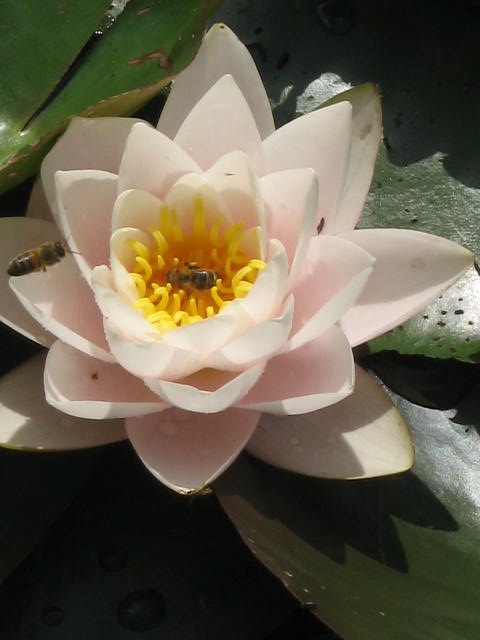
Here is one of my favourites where we caught two bees visiting a water lilly at a nearby lake.

Hope you enjoy it!

Happy if you want to use this picture yourself, so long as you refer back to this page, please!

What a strange world it is.  I met up this year with someone who I had not seen for a few years – Andrew Gough.  Andrew and I used to work together – yet we both have websites showing our passions – and they overlap with bees.

You can find our mutual interest at Andrew’s (much better laid out – in fact, beautifully constructed) site at:

http://www.andrewgough.com/bee1_1.html

There is an old tale from Scotland and the North of England that the bees buzz at midnight on Christmas Eve.  They have been doing it for centuries, apparently!

I visited my hives today – but all was quiet!  Then again, I did not visit them at midnight!

There was lots of snow, though!

A merry Christmas and successful New Year to all readers!

Three Bees

The Three Bees was a convict ship that caught fire in Sydney Cove in 1814.  She was built in Bridgewater in 1813.

Three Bees arrived in Sydney Cove, Australia, on 6 May 1814 with a cargo of 210 male convicts.  After the all the convicts were all disembarked, a fire was discovered on the ship at 4.30 pm on 20 May 1814.  It soon became apparent that the fire could not be fought and so the Three Bees was cut loose from its moorings and the other ships in the cove maneuvered to avoid the ship.

three bees

At 5.30 pm the first gun exploded on board and a swivel ball smashed into the parlour of the house of Captain Piper, luckily missing everything but a writing table. The ship drifted onto Bennelong Point (which is now where the Sydney Opera House stands) and shortly afterwards its magazine exploded. The Three Bees was a total loss.

More at: http://en.wikipedia.org/wiki/Three_Bees

Picture (which has nothing to do with the ship, except it has three bees in it!) from: http://farm3.static.flickr.com/2668/3845228494_7957e07774.jpg

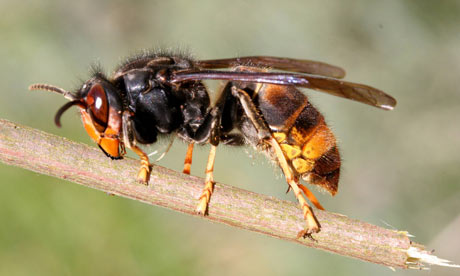
For five years they have wreaked havoc in the fields of south-western France, scaring locals with their venomous stings and ravaging the bee population to feed their rapacious appetites. Now, according to French beekeepers, Asian predatory hornets have been sighted in Paris for the first time, raising the prospect of a nationwide invasion which entomologists fear could eventually reach Britain.

Asian-predatory-hornet-Ve-001

The Asian predatory hornet, Vespa velutina. Photograph: Jean Haxaire/AFP

More at:  http://www.guardian.co.uk/world/2009/sep/25/predatory-hornet-sighting-paris-france

Honey sales in Kuwait rose 20 percent last month as people concerned about the spread of swine flu attempted to boost their immune system naturally.

Traditional medicine expert Youssef Al-Faresi told KUNA news agency that people were taking honey to ward off the H1N1 virus because of a lack of official vaccines.

“Honey is commonly known for its stigmatisation of the antibodies; it is useful for schoolchildren who could get in touch with swine flu patients,” he said.
More at: http://www.arabianbusiness.com/567106-kuwait-honey-sales-rise-on-swine-flu-fears

Bee Social

From Friday 4 September 2009 to Sunday 6 September 2009 from 12noon – close, there is a”Bee Social” going on as part of the Pestival weekend on the Southbank in London – to celebrate with the bees as the summer draws to an end.

For one weekend only, Pestival is going to transform The Front Room at Queen ‘Bee’ Hall into a giant bee hive, a place for all to learn and discuss the colony collapse disorder. Come listen to the talks, discussions as well as a special duet performance by the Royal Festival Hall’s resident bees with guest peformers.

beecab

Programme includes:
Robyn Hitchcock’s launch night on Friday 4 September spills out into The Front Room for an extended DJ set and party. Thick La Cucaracha meets Maggot from Goldy Looking Chain. Strict dress code: masks, wings and antennae!

Talkaokie who leads a round table discussion and where bee specialists are on hand to explain the plight of bees and do demonstrations. (Saturday & Sunday, from 12pm – 2pm and 4pm – 7.30pm)

Susanna Soares will showcase her pavlov’s bee device, beautiful in construction and useful tool In predicting health problems. Bees have a phenomenal odour perception. They can be trained within minutes using Pavlov’s reflex to target a specific odour and their range of detection includes pheromones, toxins and disease diagnosis. (Saturday and Sunday  at 2.30pm and 3.30pm)

North London Beekeepers who are on hand to give urban bee keeping advice. (Saturday & Sunday)

LottoLab’s The Bee Matrix, a unique exhibit of glass, light and bumblebees – part science experiment, part sculpture – to demonstrate the role of history in shaping visual behaviour. Lottolab will be on hand to engage people in their research a project Seeing Bees See. (Saturday & Sunday)

Dr. Rufus Cartright, beekeeper Steve Benbow and a group of school children who present research findings from their BeeCab summer bee/pollen pollution project. (Saturday & Sunday)

Le Suisse Marocain, a Parisian carnival artist who, in keeping with the tradition of the unknown in the ‘Old Masters’ category, calls himself ‘Le Suisse Marocain’. The role he has chosen for this is that of the artist-as-clown, and over the festive period, he paints a live mural inspired by bees in The Front Room. Come along and watch the artist create his living work.  (Saturday & Sunday)

Plus many more performances on the Larvae Stage.

More at: http://www.southbankcentre.co.uk/calendar/productions/bee-social-113f