Feeds:
Posts
Comments

Last week I bought (because I couldn’t rent it) the film by Sue Monk Kidd called “The Secret Life of Bees”.  Here is her entry on Beelore and Symbol from her website <HERE> (which tells you more about the book and film).  I love the idea that she wrote the book with a pot of honey which was an essential part of her continuing to write the book!  Pure magic!

Bee Lore and Symbol

.
“When I decided to put three beekeeping sisters into the novel, it was not because I knew anything about bees, beekeeping or honey making. I had to read lots of books. There’s a mystique about bees, a kind of spell they weave, and as I read, I fell completely under it.

Bee lore goes back to ancient times, when bees were considered a symbol of the soul, of death and rebirth. I also discovered medieval hymns that referred to the Virgin Mary as the bee hive, and Christ as the honey that flowed from her. In some stories, the Virgin Mary was associated with the queen bee, and in ancient Greece the goddess Demeter was referred to as the queen bee, and her priestesses were the worker bees, who served her.

As the epigraphs at the beginning of each chapter in the novel suggest, I thought of the pink house in the novel as a kind of hive community. As for who the queen bee in the novel might be, I’ll let you come to your own conclusions. You might be as interested as I was, though, to learn that for a very long time, beekeepers assumed that the queen was a king. It wasn’t until 1609 that people began to seriously question the existence of king bees, thanks to Charles Butler who wrote a book called The Feminine Monarchie.

Long ago, honey was regarded as a magical, sacred substance. People were buried in it, not only because it was a preservative, but because “bee-balm” as it was called, was thought to contain a resurrection potency. It was one of the libations offered to the gods of Greece, and believed to be the food of poets and muses. I’ll tell you this much, I ate honey religiously while writing The Secret Life of Bees. For some reason writing about honey made me hungry for it. I kept a jar of it sitting right on my desk. One day when I completely ran out of it, I was overcome with the desire for biscuits and honey, and abruptly stopped writing, drove to the store and bought some. Actually, I do think the writing went better after that.”

A third of UK bee colonies have been lost over the last two years and there have been many explanations given for this. There is strong evidence that neonicotinoids – a class of pesticide first used in agriculture in the mid 1990s at exactly the time when mass bee disappearances started occurring – are involved in the deaths. The evidence against these chemicals is strong enough that they have been banned or suspended in France, Germany, Italy and Slovenia – but not yet in the UK.
Neonicotinoids work as an insecticide by blocking specific neural pathways in insects’ central nervous systems. The chemicals impair bees’ communication, homing and foraging ability, flight activity, ability to discriminate by smell, learning, and immune systems – all of which have an impact on bees’ ability to survive. 

It seems bees genetic make up makes them particularly vulnerable to neonicotinoids. Recent mapping of the bee genome has revealed that bees’ capacity to detoxify chemicals is much lower than other insects. Instead bees have two strategies to protect themselves. On the first day of foraging in a new area, scout bees are sent out first to taste the nectar and pollens – if any are adversely affected they will be expelled from the hive immediately, and the colony will avoid the area.

In addition, once foraging begins, nurse bees in the hive clean foragers each time they return. These strategies protect the colony from mass exposure to lethal doses of chemicals, but they do leave honey bees particularly susceptible to sub-lethal exposures to any contaminants they encounter.

The other really important factor is the complex behaviour of honeybee colonies. For example, the 10,000 forager bees in a typical hive need to co-ordinate their quest for nectar – and they do this through the famed ‘waggle dance’, which communicates the flight direction and distance to sources of nectar. The complexity and precision of these dances is breathtaking, and success relies on the integrity of a nervous system where each synapse is crucial. It is no surprise then that honey bees have been shown to have a higher number of neurological receptors than other insects.

Honey bees live and work as a colony, not as individuals; what seems to be happening is that the cumulative impact of small doses of nenoicotinoids on thousands of bees over time is affecting individual bee’s ability to work and communicate effectively as part of a colony. Because lots of bees in each colony are behaving sub-optimally this can lead to the sudden, and devastating, outcomes that we’ve been witnessing in recent years.

The Soil Association believes that there is already enough evidence to justify an immediate ban on neonicotinoids today.

Article from The Soil Association <HERE> – with addition PDF Download: Bee briefing: The evidence that neonicotinoids are implicated in colony collapse disorder in honey bees, and should be banned in the UK

Picture below from: http://www.cbgnetwork.org/2821.html

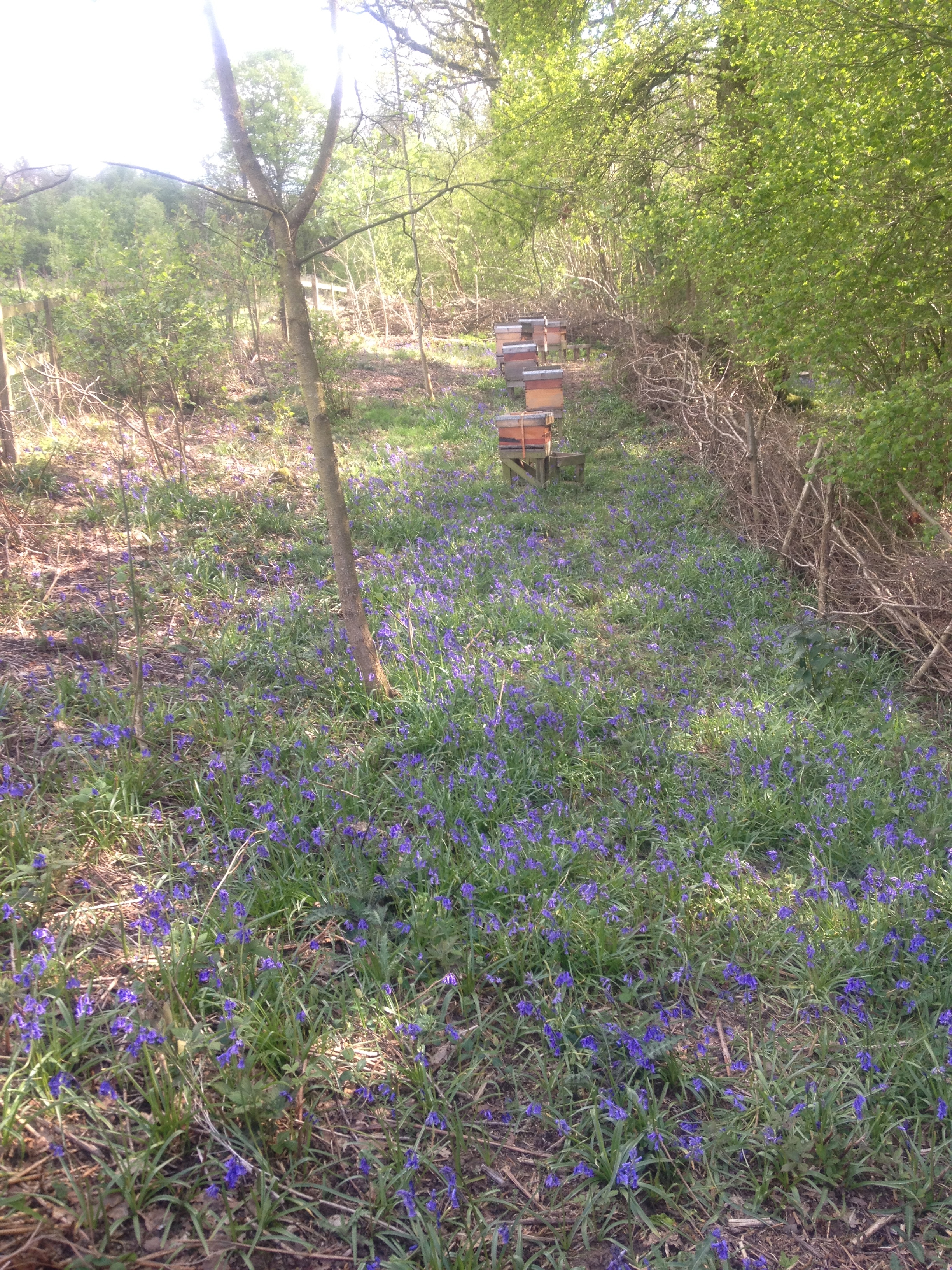
In February we moved our five hives to a new apiary.

Four have queens – and Faith is, unfortunately, Queenless.  Today (for the second time), I put a frame from Liberty into Faith to see if we can create a new queen before the workers die off.

The photograph shows the new apiary – which is surrounded by bluebells in the most beautiful wood that I can walk to.  It makes a difference from the 10 mile drive to the old (now out-apiary).  Hope you like the look of their new location!

American scientists have discovered that a fly parasite can turn honey bees into confused zombies before killing them, in an advance that could offer new clues to why bee colonies are collapsing.

So far, the parasite has only been detected in honey bees in California and South Dakota, American researchers reported in the open access science journalPLoS ONE this week.

But if it turns out to be an emerging parasite, that “underlines the danger that could threaten honey bee colonies throughout North America,” said the study led by San Francisco State University professor of biology John Hafernik.

Hafernik made the discovery by accident, when he foraged some bees from outside a light fixture at the university to feed to a praying mantis he’d brought back from a field trip.

“But being an absent-minded professor, I left them in a vial on my desk and forgot about them. Then the next time I looked at the vial, there were all these fly pupae surrounding the bees,” he said.

Soon, the bees began to die, but not in the usual way by sitting still and curling up. These bees kept trying to move their legs and get around, but they were too weak, said lead author Andrew Core, a graduate student in Hafernik’s lab.

“They kept stretching them out and then falling over,” said Core. “It really painted a picture of something like a zombie.”

Further study showed that bees that left their hives at night were most likely to become infected with the fly parasite, identified as Apocephalus borealis.

Once bees were parasitized by the fly, they would abandon their hives and congregate near lights, a very unusual behavior for bees.

More at: http://news.discovery.com/animals/parasite-bees-zombies-010512.html

2011 in review

The WordPress.com stats helper monkeys prepared a 2011 annual report for this blog.

Here’s an excerpt:

The concert hall at the Syndey Opera House holds 2,700 people. This blog was viewed about 23,000 times in 2011. If it were a concert at Sydney Opera House, it would take about 9 sold-out performances for that many people to see it.

Click here to see the complete report.

The Bee by Edwin Curran

The singing bee comes like a little ship,

And docks beside a rose for cargoed wine,

Its gossamer paddles spinning in the air

A little plane upon the flower vine.

It anchors in the bell upon its quest,

And lulls its motor in the crimson bower,

Then with its honey glides on to the west,

A tiny airplane stealing off a flower.

.

Its paddles fan the wind in silver singing,

A boom of music down the garden dells;

The honey monoplane with motors ringing,

Its gauze propellers purring like soft bells;

And so it dips and soars and dives and noses,

A little ship among the summer roses.

.

by Edwin Curran (1892-????)

The First Bees in Australia

“In 1822 the first hive bees were brought to this part of the world (Sydney), by a Captain Wallace, or Willis, in the ship “Isabella,” according to Haydon. From the bees thus introduced colonies were propagated and distributed inland. In the Government Gazette, of 21st June, 1822, there appeared this advertisement : — “Hive of bees for sale by Mr. Parr. Bees imported by Captain Wallace (or Willis).” In a number of the old Sydney Gazette, dated Friday, 1st November, 1822, there appears this paragraph: — “We congratulate our readersi upon the complete establishment of that most valuable insect, the bee, in this country. During the last three weeks three swarms of bees have been produced from two hives, the property of D. Wentworth, Esq., purchased by him from Captain Wallace, of the ‘Isabella,’ at his estate, Homebush, near Parramatta.”

“In the Sydney Morning Herald, of 10th August, 1863, it stated that at a meeting of the Acclimatisation Society of New South Wales, bees were first brought to this country by Captain Braidwood Wilson, from Hobart Town, in 1831. This was contradicted in a later issue of tTie same paper in these words: — “Bees were brought from England to Sydney in the year 1824, in the ship ‘Phoenix,’ which sailed from Portsmouth in March of that year.” This, too, is evidently a mistake, or perhaps another importation, as is evident from the fact that bees were advertised for sale in 1822, which has already been referred to. In 1840, a settler at Jervis Bay purchased two colonies of beef-‘, for which he paid £4, and engaged two aboriginals to carry the hives on their heads a distance of 40 miles. These were the black or English bees, sometimes termed the; German bee. For most of these dates and extracts I am indebted to Mr. S. M. Mowle, Usher of the Black Rod, of the Legislative Council, who married the only daughter of the late Captain Braidwood Wilson, R.N.”

From: Australian Bee Lore and Bee Culture by Albert Gale 1912.

Christmas Bee Snowflake

Snowflakes are beautiful decorations on Christmas Day. Why not make your own?

Rowse Honey had a lovely site with a bee snowflake design (see picture above).

However, the design has vanished.  I’m asking Rowse to send me a copy if they still have them.  Let’s see!

The old link was:


Make the Christmas Bee Snowflake


The Beehive Ark

I came across this amazing beehive design at a Woodfair recently.  Please find the full story of this unique design for a top-bar hive below the photograph with the designer’s contact details if you want more information:

My initial inspiration to create a curved hive was from the curved structure of honeycomb created in top-bar hives.
The design re-appropriates traditional clinker boat building techniques, and celebrates long-established craft practices in the UK; beekeeping and clinker boat building.

The beehive is created using overlapping strips of steam bent oak and chestnut. Chestnut was chosen for the roof and the base of the hive, as it is a species native to Sussex, and has good properties for use outside. The central part of the hive is made from white oak, which is traditionally used in clinker boat building.

The hive is about exploring and expanding the possibilities of existing designs to create an aesthetically satisfying and functional form, which could supplement a contemporary garden space.

Despite using unconventional techniques for making a beehive, I have ensured that the construction adheres to the basic principles in order for a top-bar hive to function effectively. A swarm shall be moved into the hive next spring, and as a continuation of the project, the bees will be documented living in it.

If you’d like to ask anything about the beehive, please contact at: kayleywillcocks(at)hotmail(dot)co(dot)uk

Bees Don’t See Red!

What colors creatures see has long interested scientists, and aside from us, more is known about what colors bees see than any other living thing.  Like us, bees are trichromatic.  Whereas we base our color combinations on red, blue, and green, bees base all their colors on UV, blue , and green.  Just as color blind people do not see red or green, and therefore experience the world of color differently, bees also perceive the world in colors entirely different from ours.  Bees do not see red and have a hard time distinguishing it from surrounding green leaf backgrounds.  Bees that frequent red flowers are either perceive them in color they can see, or the red flower is not being lost against a green background.  Even though bees don’t see red, they can see other reddish wavelengths such as orange and yellow.

The light spectrum bees see is from 600 – 300 nm. The colors bees see are blue-green, blue, violet, and ultraviolet, with research showing our purple followed by our violet then our blue as their favorites. Mixing ultraviolet wavelengths with the wavelengths of colors they can and can’t see, gives bees a world of color different from our own.   If deprived of UV light, bees lose interest in foraging, and remain in the hive until forced out by severe food shortages.

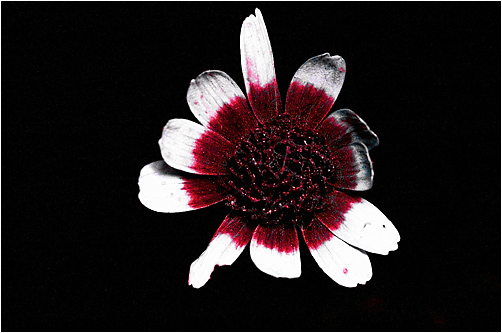
Bees not only see flowers in different colors than we do, bees also see ultra-violet light patterns, invisible to us, at the center that are a different color than the rest of the flower.   From a bee’s-eye-view, the UV colors and patterns in a flower’s petals dramatically announce the flower’s stash of nectar and pollen.  These UV patterns serve as a landing zone, guiding the bees to the nectar source.

we see 
bees see
add in UV
red black uv purple
orange yellow/green*
yellow yellow/green* uv purple
green green
blue blue uv violet
violet blue uv blue
purple blue
white blue green
black black

*even the experts don’t agree as to what colour the bee sees!

Below is a fantastic link of photographs of flowers taken with Ultraviolet filters showing the landing patterns and flouresence.
The color of these uv flowers is dependant on the filter used by the photographer, and is not the color perceived by the bee.
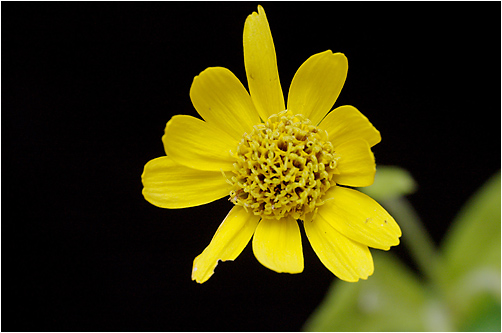
Here is a picture of Arnica angustifolia Vahl as a human might see it:
And here is a picture of the same flower as a bee might see it – with an ultraviolet “bullseye” pattern to attract the bee: