by Antonio Machado
====================
Last night, as I was sleeping,
I dreamt a marvelous error;
That I had a beehive here inside my heart.
And the golden bees were making white combs
And sweet honey from my past mistakes.
by Antonio Machado
Last night, as I was sleeping,
I dreamt a marvelous error;
That I had a beehive here inside my heart.
And the golden bees were making white combs
And sweet honey from my past mistakes.
Posted in Bee Lore, Beetwixt & Beetween | Leave a Comment »
A funny cartoon about a more serious problem. This time last year I had three hives. Today I have one.

Found at: http://www.hive-mind.com/bee/blog/2007/04/beecalpyse-now.html
Posted in Bee Present, Bee-ology, Beekeeping, Beetwixt & Beetween | Leave a Comment »
Yes, their eyes are sensitive more to the blue end of the spectrum and into ultra violet. Flowers reflect large amounts of ultra violet light and to a bee will be very bright. Bees are totally red blind.
So they can see all the colours of the rainbow including UV, but not Red or IR.
I wonder what our world would look like if we were red blind?
Fact from: http://www.beeginners.info/
Posted in Bee Present, Bee-ology, Beetwixt & Beetween | Leave a Comment »
An interesting experiment known as the SCHAFBERG experiment (named after the mountain) demonstrates the sophistication of bee navigation. The only source of food for a colony of bees was put on the far side of a mountain, the bees could not fly over the mountain only around it. What direction would the bees indicate in their dancing?. The answer was surprising, the bees indicated the direction exactly across the mountain at an angle they had never flown but had calculated in their head. The distance indication however, was for the long flight around the hill.
More at: http://www.beeginners.info/
Posted in Bee-ology, Beetwixt & Beetween | Leave a Comment »
Extract from the New Yorker Magazine 1945:
“The breeding of the bee,” says a United States Department
of Agriculture bulletin on artificial insemination,
“has always been handicapped by the fact that the queen
mates in the air with whatever drone she encounters.”
===============================================
When the air is wine and the wind is free
and the morning sits on the lovely lea
and sunlight ripples on every tree
Then love-in-air is the thing for me
I’m a bee,
I’m a ravishing, rollicking, young queen bee,
That’s me.
I wish to state that I think it’s great,
Oh, it’s simply rare in the upper air,
It’s the place to pair
With a bee.
Let old geneticists plot and plan,
They’re stuffy people, to a man;
Let gossips whisper behind their fan.
(Oh, she does?
Buzz, buzz, buzz!)
My nuptial flight is sheer delight;
I’m a giddy girl who likes to swirl,
To fly and soar
And fly some more,
I’m a bee.
And I wish to state that I’ll always mate
With whatever drone I encounter.
There’s a kind of a wild and glad elation
In the natural way of insemination;
Who thinks that love is a handicap
Is a fuddydud and a common sap,
For I am a queen and I am a bee,
I’m devil-may-care and I’m fancy-free,
The test tube doesn’t appeal to me,
Not me,
I’m a bee.
And I’m here to state that I’ll always mate
With whatever drone I encounter.
Mares and cows. by calculating,
Improve themselves with loveless mating,
Let groundlings breed in the modern fashion,
I’ll stick to the air and the grand old passion;
I may be small and I’m just a bee
But I won’t have science improving me,
Not me,
I’m a bee.
On a day that’s fair with a wind that’s free,
Any old drone is a lad for me.
I’ve no flair for love moderne,
It’s far too studied, far too stern,
I’m just a bee—I’m wild, I’m free,
That’s me.
I can’t afford to be too choosy;
In every queen there’s a touch of floozy,
And it’s simply rare
In the upper air
And I wish to state
That I’ll always mate
With whatever drone I encounter.
Man is a fool for the latest movement,
He broods and broods on race improvement;
What boots it to improve a bee
If it means the end of ecstasy?
(He ought to be there
On a day that’s fair,
Oh, it’s simply rare.
For a bee.)
Man’s so wise he is growing foolish,
Some of his schemes are downright ghoulish;
He owns a bomb that’ll end creation
And he wants to change the sex relation,
He thinks that love is a handicap,
He’s a fuddydud, he’s a simple sap;
Man is a meddler, man’s a boob,
He looks for love in the depths of a tube,
His restless mind is forever ranging,
He thinks he’s advancing as long as he’s changing,
He cracks the atom, he racks his skull,
Man is meddlesome, man is dull,
Man is busy instead of idle,
Man is alarmingly suicidal,
Me, I am a bee.
I am a bee and I simply love it,
I am a bee and I’m darn glad of it,
I am a bee, I know about love:
You go upstairs, you go above,
You do not pause to dine or sup,
The sky won’t wait —it’s a long trip up;
You rise, you soar, you take the blue,
It’s you and me, kid, me and you,
It’s everything, it’s the nearest drone,
It’s never a thing that you find alone.
I’m a bee,
I’m free.
If any old farmer can keep and hive me,
Then any old drone may catch and wife me;
I’m sorry for creatures who cannot pair
On a gorgeous day in the upper air,
I’m sorry for cows that have to boast
Of affairs they’ve had by parcel post,
I’m sorry for a man with his plots and guile,
His test-tube manner, his test-tube smile;
I’ll multiply and I’ll increase
As I always have—by mere caprice;
For I am a queen and I am a bee,
I’m devil-may-care and I’m fancy-free,
Love-in-air is the thing for me,
Oh, it’s simply rare
In the beautiful air,
And I wish to state
That I’ll always mate
With whatever drone I encounter.
===========================================
From: http://ourworld.compuserve.com/homepages/beekeeping/ebwhite.htm
Posted in Bee Law, Bee Lore, Bee Present, Bee-ology | Leave a Comment »
Apparently St Ambrose didn’t have anything directly to do with bees, but had the title “Honey Tongued Doctor” because of his speaking and preaching ability. This led to the use of a beehive and bees as his symbols, as you can see here:

More at: http://membracid.wordpress.com/2008/03/12/beekeeping-patron-saints/
Posted in Bee Lore, Beekeeping | 3 Comments »
The beekeeping lady then worked quickly. She put a large sheet on the ground and put the box with the bees on top. In a very short space of time all the bees were gone and there was no more noise. She slowly lifed the box and put it back into her car.
She then removed her veil and her beuatiful face shone as she presented us with two pots of unlabelled honey! It was very kind of her, since I thought we might have to pay her to take the bees away. Sometimes Dad paid our gardener, Jack, a little extra to help him trap the moles. And Mum had paid the rat catcher last year to come and remove the rats from the back sheds. Why should the Beekeeping lady actually give us a present for taking these stinging insects away from our garden? All these unanswered questions.
Mum asked the beekeeping lady if she would like a cup of tea. (Mum always offered visitors a cup of tea). However, the beekeeping lady said that she had to get the bees into a hive before the sun went down. She left quietly, efficiently and gracefully, almost like an angel might vanish behind a cloud.
And we were left with the two jars of honey. We opened one of them straight away and had honey on toast for tea in the chairs which had been laid out by Mum next to the Willow Tree. The honey was delicious! And what an eventful afternoon it had been!
Posted in Beekeeping, Beetwixt & Beetween, Bylaugh | Leave a Comment »
The oldest pictures of bee-keepers in action are from the Old Kingdom of Ancient Egypt. In Niuserre’s sun temple bee-keepers are blowing smoke into hives as they are removing the honey-combs. After extracting the honey from the combs it was strained and poured into earthen jars which were then sealed. Honey treated in this manner could be kept years. From the New Kingdom on, mentions of honey and depictions of its production become more frequent.

Bee-keeping methods are conservative in this region, well adapted to local conditions, for instance the kind of hives shown in these ancient reliefs, apparently woven baskets covered with clay, are still seen in the Sudan today.
The main centre of bee-keeping was Lower Egypt with its extensive cultivated lands, where the bee was chosen as a symbol for the country. One of Pharaoh’s titles was Bee King, and the gods also were associated with the bee. The sanctuary in which Osiris was worshiped was the Hwt bjt, the Mansion of the Bee.
There were itinerant apiarists in the Faiyum in Ptolemaic times using donkeys to transport their hives and possibly also beekeepers living by the Nile who loaded their hives onto boats, shipped them upriver in early spring, and then followed the flowering of the plants northwards as they were reported to do in the 19th century CE.
The Egyptians had a steady honey supply from their domesticated bees, but they seem to have valued wild honey even more. Honey hunters, often protected by royal archers, would scour the wild wadis for bee colonies.
I appointed for thee archers and collectors of honey, bearing incense to deliver their yearly impost into thy august treasury.
From: http://www.reshafim.org.il/ad/egypt/timelines/topics/beekeeping.htm
See also: https://beelore.com/2008/01/13/egypt-unites-the-reed-and-the-bee/
and: https://beelore.com/2007/08/24/tears-of-ra-the-sun-god/
Posted in Bee Lore, Beekeeping | 18 Comments »
Cranach painted the first version of Cupid Complaining to Venus in 1527; in subsequent years, he and his workshop produced at least twenty-five versions of the theme, a fine example of which is now in the National Gallery.

A Dürer watercolour of 1514, to which Cranach’s paintings are unrelated, is the earliest known visual interpretation of the theme in the Northern European artistic context. The subject ultimately derives from pseudo-Theocritean Idyll XIX, (the Honey Thief), which tells the story of Cupid’s complaint to his mother after being stung by a bee as he was stealing a honeycomb.
From: http://www.blackwell-synergy.com/doi/pdf/10.1111/j.1477-4658.2007.00337.x?cookieSet=1
Posted in Bee Lore, Beetwixt & Beetween | Leave a Comment »
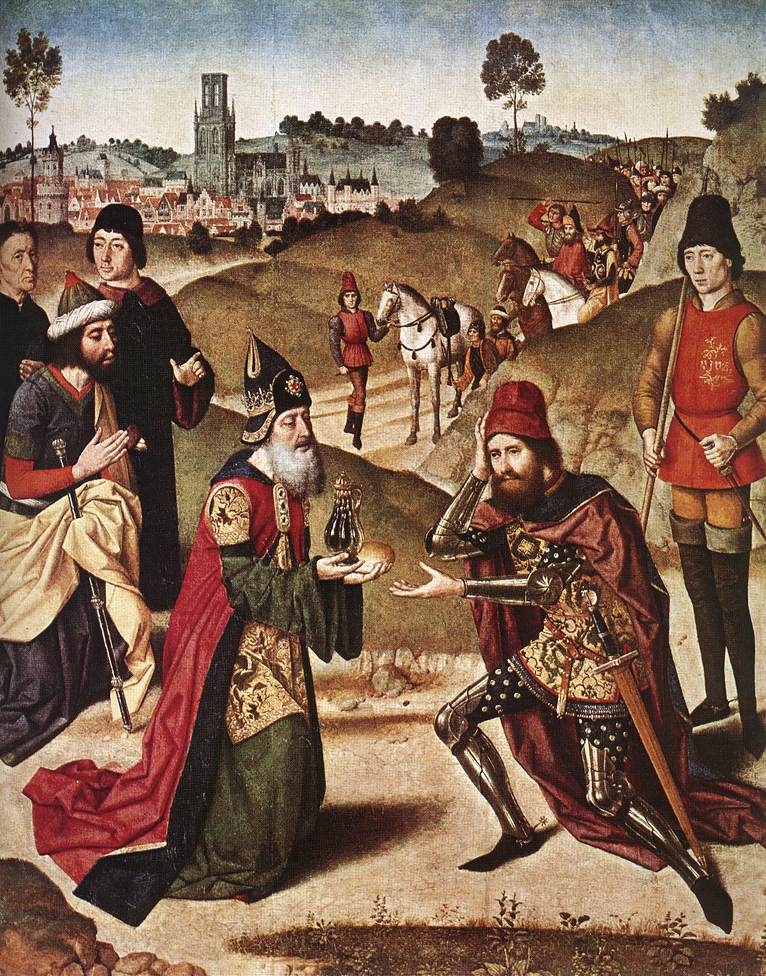
Occult tradition states that the mysterious figure Melchizedek, who is mentioned in the Bible in connection with giving communion to the patriarch Abraham, is an entity that brought three gifts to earth from the planet Venus: the bee, wheat, and the mineral asbestos.

The tradition is an allegorical one. The meaning of the three gifts may be partially understood as symbolizing three grades of initiation. In the first grade, one serves (bee). In the second grade, the initiate focuses on understanding and practicing the development of the many out of the one (wheat). In the third grade, the initiate becomes a channel of the Divine Fire; he burns, but is not consumed (asbestos).
Story from: http://www.polarissite.net/page26.html
Picture from: http://en.wikipedia.org/wiki/Image:Meeting_of_abraham_and_melchizadek.jpg
Posted in Bee Lore, Beetwixt & Beetween | 10 Comments »
 Bee Lore