Feeds:
Posts
Comments

“As busy as a bee.”

“What is good for the swarm is not good for the bee.”

“Where there is honey, there are bees.”

“One bee is better than a handful of flies.”

“If you want to gather honey, don’t kick over the beehive.”

“Honey turns sour.”

“The diligence of the hive produces the wealth of honey.”

“A drop of honey will not sweeten the ocean.”

=====================================

The proverbs are from Insect Fact and Folklore , by Lucy W. Clausen. Published by Collier Books, N.Y., 1954.

List of Lores

For those interested, here is a great list of other Lores:

http://anglish.wikia.com/wiki/List_of_Lores

Bees Can Count!

Honeybees are clever little creatures. They can form abstract concepts, such as symmetry versus asymmetry, and they use symbolic language — the celebrated waggle dance — to direct their hivemates to flower patches. New reports suggest that they can also communicate across species, and can count — up to a point.

With colleagues, Songkun Su of Zhejiang University in Hangzhou, China, and Shaowu Zhang of the Australian National University in Canberra managed to overcome the apian impulse to kill intruders and cultivated the first mixed-species colonies, made up of European honeybees, Apis mellifera, and Asiatic honeybees,A. cerana. The researchers confirmed that the two species have their own dialects: foraging in identical environments, the bees signaled the distance to a food source with dances of different durations.

Remarkably, despite the communication barrier, A. cerana decoded A. mellifera’s dance and found the food.

From: http://www.clipmarks.com/clipmark/AC3920A0-F84A-4A34-A1FD-02E2769308F6/

Magic Presents from the Bees

A bee comb has six sides,

on each a magic thing it hides:

Take wax, pollen and a spoon of honey 

which will make you healthy and sunny

Try propolis, royal jelly or venom

and you’ll enjoy bee’s poem!

Adapted from: http://www.bee-hexagon.net/

Bee Law: Possession of Bees

Blackstone Commentaries, Book II divides the entire animal kingdom into two classes.  Domesticated animals (ferae domitia) and wild (ferae naturae).   Wild animals are also divided into two classes — those free to roam at will and those which have been subjected to man’s dominion.

The honey bee that exists in the wild (lives in a tree cavity) is little different from the honey bee that lives within a man-made hive.   However, honey bees do swarm and thus are free to roam at will.  Honey bees do not trespass and the owner of property has no title to wild things using his property.  The owner of property can prevent others from coming onto his/her property and taking them and the property owner has a right to capture a swarm and hive it. Trespassing is a violation of the law and is enforceable.

“So long as bees remain in the hive of the claimant and on his premises or premises under his control, they are his.” (Supra.§ 5).

It is when they leave his/her hive and premises, as in swarming, that complications arise.  Case law has reflected the general idea that as long as the beekeeper keeps the swarm in sight and can identify them has his/hers, the beekeeper retains ownership of the bees. However, in getting the bees hived, one may be charged with trespassing.

From: http://www.gobeekeeping.com/LL%20lesson%20six.htm
In the creation story of the Kalahari Desert’s San people, a bee carries a mantis across a river. The river is wide, and the exhausted bee eventually leaves the mantis on a floating flower. The bee plants a seed in the mantis’s body before dying, and the seed grows into the first human.

From: http://animals.howstuffworks.com/insects/bee.htm

Prehistoric Ape-iarists?

Apparently chimpanzees hunt honey in Africa in the same way that people do.  They follow the honeyguide bird to where the bees are.  The males then go up the tree first to collect the honey and they even use tools such as stones and sticks to get at the honey!

One wonders whether the practice of apes collecting honey is more ancient than even our oldest history books give account?  What is Bee Lore without the written word?  Perhaps it is a story that has been handed down (and distorted) through many generations?  Or maybe just a thought about something that is Bee Present like this one?

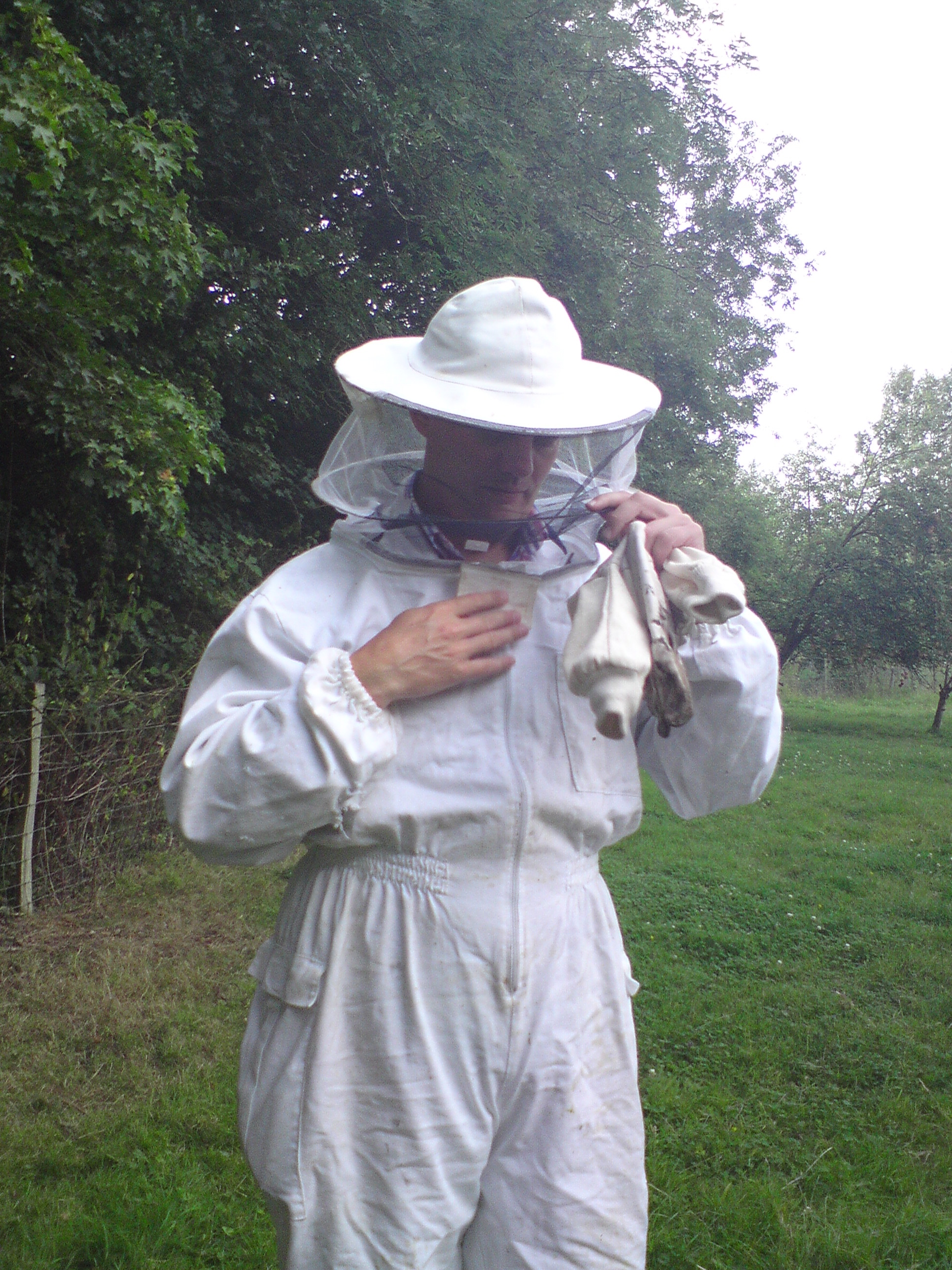
Hole in my veil…beeware!

The weather has been good over the past week and I have visited the hives twice……

Two of the hives are not going to make it over winter – the last two swarms that were caught in late June (Kilndown and Hawkhurst).  However, we should get Joy, Harmony, Faith, Grace (weakest of these five) and Prior’s Heath through the winter with a bit of luck….which would be good considering we only had one colony at the start of this year.  That is the good news.

The not-so-good news for those of you who have had honey from us in the past few years is that I have decided to leave all the honey on the hives……we could have taken two supers….but would have left Grace and Prior’s Heath without enough winter stores…..and I am not sure that they would have packed-down enough stores by simply feeding them syrup.

Grace and Faith also showed signs of verroa…..with bees quite diseased flying in and out…..so hopefully the treatment will work on them.

Strange with the credit crunch.  It is somehow that the bees themselves are keeping their liquid assets in the bank and that there is no dividend or bonus for us this year.  The analogies between the bee world and the human world remain fascinating to me as I start a new venture.  I might write more on this.  I am inspired to even write a new section of this blook!  Watch this space!

The Properties of Bees

The properties of bees are wonderful noble and worthy. For bees have one common kind as children, and dwell in one habitation, and are closed within one gate: one travail is common to them all, one meat is common to them all, one common working, one common use, one fruit and flight is common to them all, and one generation is common to them all.

From: De proprietatibus rerum