Feeds:
Posts
Comments

Black or White?

The flowers were blooming on the peach trees the first time I went out to photograph bees.

After being told what I would need to do and where I would need to stand I was told to change into something white.

But why? I asked.

“Because you’re wearing black jeans and a dark sweater. To the bees you look like a polecat, a bear – something come to steal the honey,” was his reply.

How odd, I thought – that bees would practice profiling.

============================

Thanks for leaving this story, Becky!

Another point of view

Following my post below, here is another TED talk that sees the world from the point of view of bees and plants.

Makes you think!

Thoughts of my missing hives (60% last winter, 16% this winter) took me here. Well worth a watch!

I am a TED fanatic! If you have not seen their amazing set of free talks, they are well worth an hour or two to look around. Each talk lasts for about 20 minutes – so you won’t get bored.

More at www.ted.com

The Lords of Wisdom

Some beautiful stories from Scotland – a true source of Celtic lore. I love the idea that the bees know so much and are in harmony withe the wind and the rain!

“In Ross, I was told by a man of the Gairloch, they speak . . . in a folk-tale I think he said, but possibly colloquially . . . of the bees as “lords of wisdom” or “the little kings of wisdom.” It is a fine phrase, that . . . the lords of wisdom: and not one to forget.

Oftenest, however, the allusions to the bee are, doubtless, to its “knowingness” rather than to its “wisdom”; its skill in tracking the pathless ways, its intuition of the hour and season, of the way of the wind, of the coming of rain, of gathering thunder.”…….

From: The Works of Fiona Macleod, Volume V, The Sunset of Old Tales

More at: http://www.sundown.pair.com/SundownShores/Volume_V/lords_of_wisdom.htm

One Hive Lost

I looked at my six hives a few weeks ago, relieved that they had all made it through the winter.  However, Patience was not laying.

When I looked again a few days ago, Patience had vanished!

This colony collapse thing is hard to understand.

Still, we have five remaining – three of which should produce honey, providing we get through the swarm season without losing a swarm from each.

All the joys of beekeeping!

I met an interesting lady on the aeroplane today who told me that her mother kept bees on the Island of Jersey.

When the bees started to swarm, her mother used to tell all her children (she had eight!) to run into the garden with pots and pans and bash them as hard as they could and make as much noise as they could, so that the bees would settle and not fly away.  Her mother would then gather the bees up and put them back in the hive.  She said it really worked.

I said I was not sure if the bees would naturally go back into their old hive if they have swarmed….to which she said that maybe her mother put them in a new hive.

There is a technical word for this banging of pots and pans – which is called “Tanging” – a descrption of which is in Simon Buxton’s book – The Shamanic Way of the Bee.

I also found this older reference:

Engraving from Dutch book

Above is a plate from a Dutch book showing tanging.

“In this late 17th-century engraving from a book printed in Amsterdam, a swarm can be seen coming out of one of the straw hives or ‘skeps’ in the middle of the picture. A beekeeper stands to the right and hits what looks like a metal pan or drum in a procedure known as ‘tanging’. Tanging would alert the neighbourhood that bees are swarming and its rhythmic sound would help coax the bees into the overturned hive in the foreground. This empty hive would also have been lined with honey in order to entice the bees to take up residence within it”

“Tanging was also a way for a beekeeper to alert other beekeepers that a claim was being made on a found swarm. Acquiring new bees by laying claim to a swarm was important, as it was routine at this time for beekeepers to asphyxiate their bees with fumes from burning sulphur in order to access the honeycomb safely.”

I am interested to know if any readers have heard of this ritual and any other reasons that beekeepers might do it.

Plate and text in quotation marks from: http://www.nls.uk/moir/tanging.html

There is an old English expression:

“Ask the wild bee what the Druids knew”

Intriguing.  It gives a hint of mystery and pagan ritual – as well as a harking back, perhaps, to a time in early English history when we were much closer to the bees and they to us.

Would very much like to know if anyone else has an interesting interpretation of this!

Giving and Receiving

For to the bee a flower is a fountain of life

And to the flower a bee is a messenger of love

And to both, bee and flower,

the giving and the receiving is a need and an ecstasy.

~ Kahlil Gibran

See: bountifulhealing.wordpress.com/2007/08/04/

How Do Bees Make Honey?

Firstly, worker bees fly out from the hive in search of nectar-rich flowers. Using its straw-like proboscis, a worker bee drinks the liquid nectar and stores it in a special stomach called the honey stomach. The bee continues to forage, visiting hundreds of flowers, until its honey stomach is full. Within the honey stomach, enzymes break down the complex sugars of the nectar into simpler sugars, which are less prone to crystallization. This process is called inversion. With a full belly, the worker bee heads back to the hive.

Once back in the hive, the worker bee then regurgitates the already modified nectar for one of the hive bees.  The hive bee ingests the sugary offering and further breaks down the sugars. It then regurgitates the inverted nectar into a cell of the honeycomb.  The hive bees then beat their wings furiously, fanning the nectar to evaporate its remaining water content. As the water evaporates, the sugars thicken into honey. Once the honey is finished, the hive bee caps the beeswax cell, sealing the honey into the honeycomb for later consumption.

A single worker bee produces only 1/12th of a teaspoon of honey in her lifetime. Working cooperatively, thousands of worker bees can produce over 200 pounds of honey for the colony within a year.

From: http://insects.about.com/od/antsbeeswasps/f/beesmakehoney.htm

Bee’s Eyes

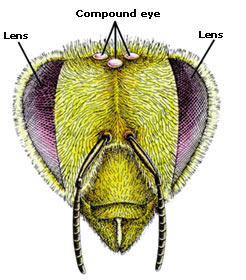
The bee’s eyes, like those of other insects, differ greatly from human eyes. They consist of a pair of compound eyes made up of numerous six-sided facets. They also have three simple eyes.  Despite this, their vision is believed to be sharp for a distance of only about 1 m (3 ft.).  The picture below highlights the three simple eyes as “Compound Eye” which is a mistake, I believe – but otherwise it is a good picture.  The two, large, compound eyes are titled “Lens”.

bees-eyes

Bees are capable of seeing ultraviolet light, which is invisible to humans. The bee is capable of navigating by ultraviolet light, which even penetrates cloud cover.

From: http://nature.ca/notebooks/english/bees.htm

Picture from: http://www.islamicmiraclestoday.com/honey-bee3/the-bees-eye.html