Feeds:
Posts
Comments

Archive for the ‘Beetwixt & Beetween’ Category

Eddie: Say, was you ever bit by a dead bee?
Beauclerc: I have no memory of ever being bitten by any kind of bee.
Slim: Were you?
Eddie: You’re all right lady. You and Harry’s the only one that ever—
Harry: Don’t forget Frenchy.
Eddie: That’s right. You and Harry and Frenchy. You know you gotta be careful of dead bees, if you go around barefooted. Cause if you step on ‘em they can sting ya just as bad as if they was alive, especially is they was kinda mad when they got killed. I bet I been bit a hundred times that way.
Slim: You have. Why don’t you bite them back?
Eddie: That’s what Harry always says. But I ain’t got no stinger.

===============================================

From: “To Have and Have Not” (1944). 

By: Jules Furthman (1888–1960), U.S. screenwriter, William Faulkner (1897–1962), U.S. author, screenwriter, and Howard Hawks.

With: Eddie (Walter Brennan), Beauclerc (Paul Marion), Slim/Marie Brown (Lauren Bacall), Harry Morgan (Humphrey Bogart)

By answering Eddie’s nonsensical question correctly, Slim earns entree into Harry’s and Eddie’s tight-knit group.

===============================================

I once met a beekeeper who said it was possible to inject sufferers of arthritis with stings from dead bees to help ease the ailment.  However, I have never tried it!  Odd as it seems, dead bees can sting you – particularly if , like Eddie, you tread on hundreds of them with bare feet!

Read Full Post »

“Most of the bees come to their end in the open fields. With wings frayed from the winds the summer workers reach the limit of their strength and expire.  Bees that die within the hive are carried outside by the workers – yet this is a rare occurrence.  As many observers have reported, dying bees will use their last remaining strength to creep beyond the landing board.  A Law of the insect city apparently leads the exhausted bees to leave the interior of the hive and so save their fellow workers the task of removing their bodies.  The queen seems to be guided by the same instinct, leaving the hive when her end is near.  For cleanliness is one of the unwritten laws of the insect city. It is inherent in the bees. ”

From: ‘The Golden Throng’ by Edwin Way Teale – republished by Alpha Books of Dorset in 1968.

Read Full Post »

I have a very old friend who lives in Scotland.  He told me of an uncle of his who used to keep bees in his roof garden in Edinburgh.  Unfortuately, his uncle died and the day of his dead uncle’s funeral, arrangements were made for a hearse to take his body to the local church.  The story goes that the bees swarmed and followed the hearse down the road to the church.  What a beautiful send-off from the bees!

Read Full Post »

One of the most intriguing things that I have learnt about bees is the unexplainable magic of drone congregation areas.  Why magic?  On lazy-hazy sunny days, year after year, genration after generation, drones will congregate in particular areas to wait for any passing queens that need mating.  Yet how do the drones know where these areas are when when old drones are kicked out of the hives in Autumn and a new generation of drones only reappear the next year when the queen starts laying new drones in the Spring? 

Pushed Away Drone Bees.jpg

Drones being pushed out of the hive in Autumn

Geographic knowledge passed on from one generation of drones to the next without direct communication – as if by magic!  Perhaps the same magic that birds use generation-after-generation to migrate from one part of the world to another?

Read Full Post »

The Appearance

The next second or two are a blank. Just as people in an accident can often remember some parts with extreme clarity and then blank-out, so I had a blank moment. I suppose it makes sense if you think about it. All these sensations and feelings piled up into a couple of seconds must mean that your brain has gone into overload. My brain must have done that. I didn’t run. I didn’t get a large adrenalin-rush and feel my heart race at double its normal pace. I just stood there and watched in awe. It was a bit like watching one of those old movies when the frames don’t quite mesh together and time jumps from one scene to the next leaving a bit out in the middle. That is what happened. One moment I was looking at the dark sun with the indescribable humming noise. The next thing I remember was looking at the railing on the fence about two metres in front of me to see a large black ball appear. It seemed to grow in front of me like a balloon which was being blown up – and it kept on getting larger and larger until eventually the buzzing got quieter, the sun returned to its normal brightness and the balloon became a large black blob about the size of a medicine ball with a moving skin.

Read Full Post »

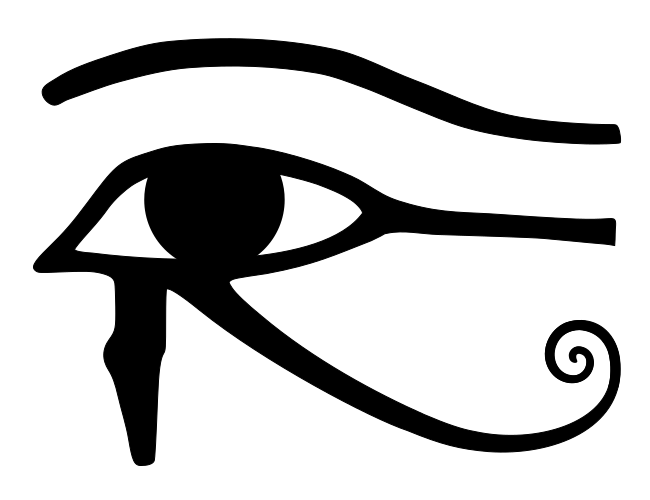
According to one ancient egyptian myth, honey bees were the tears of the sun god Ra.  In this context, the bee was seen as the messenger of the gods, falling down, like tears, towards the earth (and man) to pass on some secret message.


The above symbol was called the Udjat in ancient times.  It is now more commonly called the Eye of Ra or Eye of Horus and represents the right eye of the Egyptian Falcon God Horus and was also associated with the Sun God Ra.  It is supposed to be where the tears (or bees) came from.

According to another legend, the left eye was torn from Horus by his brother Seth. It was magically restored by Thoth, the God of Magick.  After the restoration, some stories state, Horus made a gift of the eye to Osiris, which allowed this solar deity to rule the underworld.

The Eye of Horus was also believed to have healing and protective power, and it was used as a protective amulet, and as a medical measuring device, using the mathematical proportions of the eye to determine the proportions of ingredients in medical preparations) to prepare medications. The Egyptians did write prescriptions. Those prescriptions were composed first of magical verses and then secondly the real prescription. The Eye of Horus was an important part of the magical part of the prescription. With time the magical part became smaller, and the real prescription more important.  Eventually, all that was left of the magical verse was the Eye of Horus. The sign has remained in pharmacist’s shorthand to this day with Rx being the sign for a prescription!  Many bee products are used for healing and it is likely that there the direct connection between bees and good health goes back before Ancient Egypt.

Together, the left and right eyes represented the whole of the universe, a concept similar to that of the Taoist Yin-yang symbol.  Spiritually, the right eye reflects solar, masculine energy, as well as reason and mathematics.  The left eye reflects fluid, feminine, lunar energy, and rules intuition and magic.  Together, they represent the combined, transcendent power of Horus.

Read Full Post »

A story of eastern European origin probably derives from a time when many gods were worshipped, later being altered to conform with the Christian monotheistic concept:

The devil was spying on God when He was creating the birds and insects. God took a bit of mist from the air, spun it in His fingers and called out the name of the new creature, “Bee!” And so the first bee was brought to life. The devil was a bit confused by what he saw and thought that God had called the creature into existence by telling it to “Be!” So when he tried a similar trick, gathering up a bit of clay from the earth and mixing it with his own sweat he told it to “Fly!” Of course, in this way it was not another beautiful bee that was formed but the ugly and pesky fly that, ever since, has plagued humans as much as bees have benefitted them.

From: http://healing.about.com/gi/dynamic/offsite.htm?zi=1/XJ&sdn=healing&zu=http%3A%2F%2Fwww.geocities.com%2FTimesSquare%2FLabyrinth%2F2398%2Fbginfo%2Fbeast%2Fbees.html

(The author altered the “letter” of the story a bit to maintain its spirit. In the original, Hungarian, version the word-play centers on “legy” meaning both “become” and a “fly”).

Read Full Post »

(From Leo Tolstoy’s War & Peace: Chapter IV)

 As the sun and each atom of ether is a sphere complete in itself, and yet at the same time only a part of a whole too immense for man to comprehend, so each individual has within himself his own aims and yet has them to serve a general purpose incomprehensible to man.

A bee settling on a flower has stung a child. And the child is afraid of bees and declares that bees exist to sting people. A poet admires the bee sucking from the chalice of a flower and says it exists to suck the fragrance of flowers. A beekeeper, seeing the bee collect pollen from flowers and carry it to the hive, says that it exists to gather honey. Another beekeeper who has studied the life of the hive more closely says that the bee gathers pollen dust to feed the young bees and rear a queen, and that it exists to perpetuate its race. A botanist notices that the bee flying with the pollen of a male flower to a pistil fertilizes the latter, and sees in this the purpose of the bee’s existence. Another, observing the migration of plants, notices that the bee helps in this work, and may say that in this lies the purpose of the bee. But the ultimate purpose of the bee is not exhausted by the first, the second, or any of the processes the human mind can discern. The higher the human intellect rises in the discovery of these purposes, the more obvious it becomes, that the ultimate purpose is beyond our comprehension.

All that is accessible to man is the relation of the life of the bee to other manifestations of life. And so it is with the purpose of historic characters and nations.


Read Full Post »

An omphalos is a religious stone artifact in the ancient world. In Greek, the word omphalos means “navel”.  According to the ancient Greeks, Zeus sent out two eagles to fly across the world to meet at its center, the “navel” of the world.  Omphalos stones used to mark this point were erected in several areas surrounding the Mediterranean Sea – the most famous of which was at the Oracle in Delphi.  The ancient Greeks used to seek out the Priestesses of the Oracle to answer questions about the future and past.  The Priestesses sat on tri-legged stools near a spot where vapours rose up through an omphalos stone.  The omphalos stone was carved, hollow, domed-shaped and looked like a bee hive.  An example of the one from Delphi (which may be a copy of the original) is shown below:

Omphalos from Delphi

If you look closely, you will see that the omphalos has carvings of bees on it!  There are many other beautiful stories of the bees being guardians or entry-points to other worlds and that they can help us uncover truths of the past, present and future.

Read Full Post »

« Newer Posts