Feeds:
Posts
Comments

Archive for the ‘Beekeeping’ Category

Blackstone Commentaries, Book II divides the entire animal kingdom into two classes.  Domesticated animals (ferae domitia) and wild (ferae naturae).   Wild animals are also divided into two classes — those free to roam at will and those which have been subjected to man’s dominion.

The honey bee that exists in the wild (lives in a tree cavity) is little different from the honey bee that lives within a man-made hive.   However, honey bees do swarm and thus are free to roam at will.  Honey bees do not trespass and the owner of property has no title to wild things using his property.  The owner of property can prevent others from coming onto his/her property and taking them and the property owner has a right to capture a swarm and hive it. Trespassing is a violation of the law and is enforceable.

“So long as bees remain in the hive of the claimant and on his premises or premises under his control, they are his.” (Supra.§ 5).

It is when they leave his/her hive and premises, as in swarming, that complications arise.  Case law has reflected the general idea that as long as the beekeeper keeps the swarm in sight and can identify them has his/hers, the beekeeper retains ownership of the bees. However, in getting the bees hived, one may be charged with trespassing.
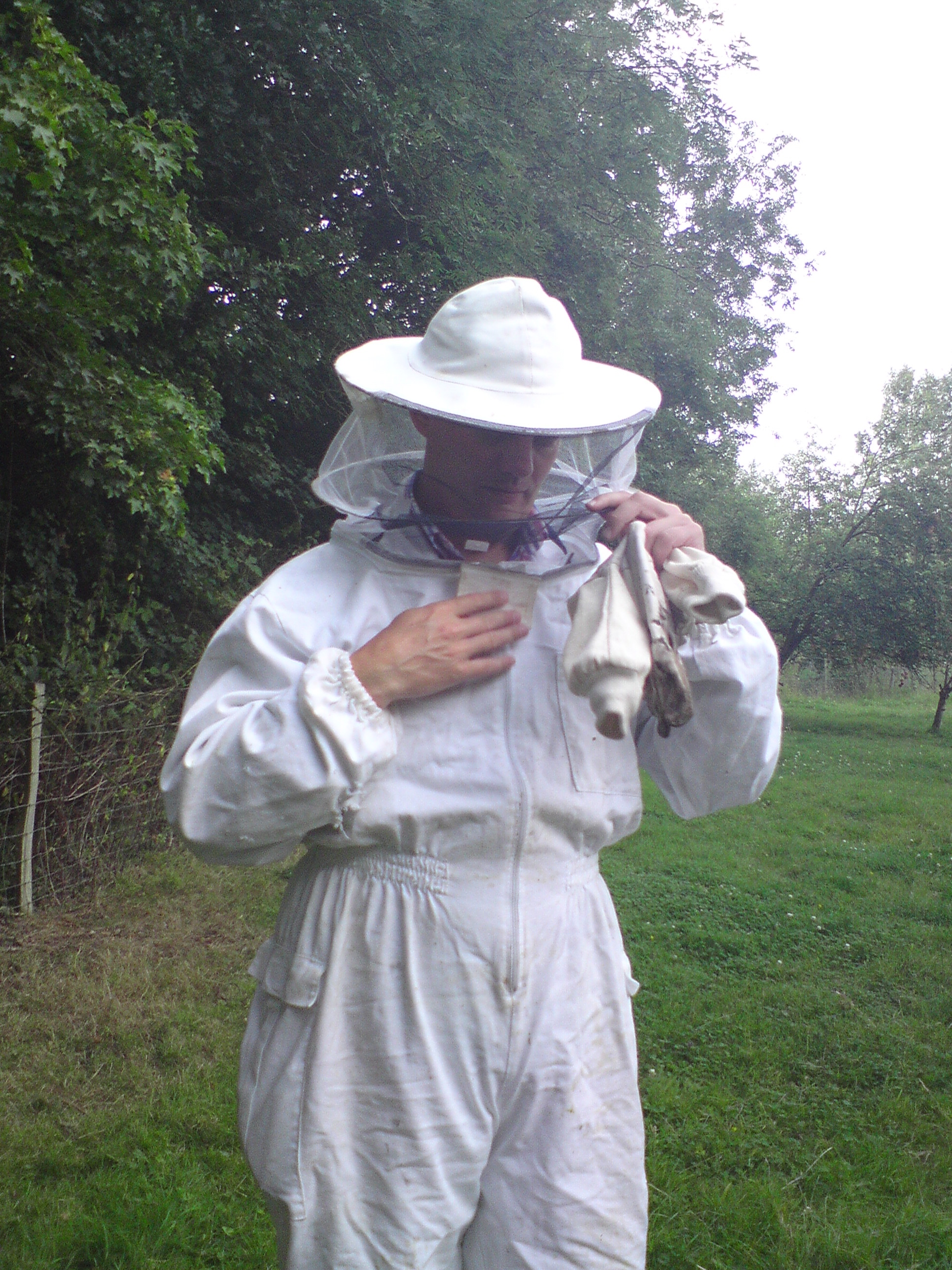
From: http://www.gobeekeeping.com/LL%20lesson%20six.htm

Read Full Post »

Apparently chimpanzees hunt honey in Africa in the same way that people do.  They follow the honeyguide bird to where the bees are.  The males then go up the tree first to collect the honey and they even use tools such as stones and sticks to get at the honey!

One wonders whether the practice of apes collecting honey is more ancient than even our oldest history books give account?  What is Bee Lore without the written word?  Perhaps it is a story that has been handed down (and distorted) through many generations?  Or maybe just a thought about something that is Bee Present like this one?

Read Full Post »

Read Full Post »

The weather has been good over the past week and I have visited the hives twice……

Two of the hives are not going to make it over winter – the last two swarms that were caught in late June (Kilndown and Hawkhurst).  However, we should get Joy, Harmony, Faith, Grace (weakest of these five) and Prior’s Heath through the winter with a bit of luck….which would be good considering we only had one colony at the start of this year.  That is the good news.

The not-so-good news for those of you who have had honey from us in the past few years is that I have decided to leave all the honey on the hives……we could have taken two supers….but would have left Grace and Prior’s Heath without enough winter stores…..and I am not sure that they would have packed-down enough stores by simply feeding them syrup.

Grace and Faith also showed signs of verroa…..with bees quite diseased flying in and out…..so hopefully the treatment will work on them.

Strange with the credit crunch.  It is somehow that the bees themselves are keeping their liquid assets in the bank and that there is no dividend or bonus for us this year.  The analogies between the bee world and the human world remain fascinating to me as I start a new venture.  I might write more on this.  I am inspired to even write a new section of this blook!  Watch this space!

Read Full Post »

An interesting u-tube demo on how to make a Willow Skep can be found at:

http://www.larsdatter.com/beehives.htm


Read Full Post »


Bees have devised a very effective method of communicating information about sources of food using a ROUND DANCE and a WAGGLE DANCE (or figure of eight). The dances do not appear to indicate the height of the food above ground level and in most cases this is not important since to a bee the source will be obvious.

Round Dance

This is used when the source of food (nectar or pollen) is less than 100 metres away. The bee dancing goes in a circle on the comb first one way, she turns round and then the other way round the circle. Food is passed from the dancing bee to those watching and following giving information about it’s taste and smell. The round dance does not appear to tell the bees in which direction to go to the food source just that the food “is close to the hive and tastes and smells like this”.

Waggle Dance

For food supplies more than 100 metres the waggle dance is used. The bee will run in a direction on the comb which indicates direction relative to the sun’s position. The bee uses the force of gravity (vertically downwards) as the position of the sun and if say the food is 30 ° to the left of the sun then the bee will dance 30 ° to the left of the vertical on the frame. Whilst the bee is indicating direction she waggles her body from side to side to indicate distance to the food source. The more waggles the closer the food source is to the hive.

The waggle dance gives both direction and distance to the food source and by tasting the food the bee knows what to look for.

From: http://www.cheshire-bka.co.uk/Beekeeping/beedance.php


Read Full Post »

It was a year ago yesterday that I started writing this blook.  I never dreamt that it would get so big and have so many entries and have received so many hits by now.  It has been a great way to relax in the evenings after work as well as a good place to record some of the happenings in the apiary – though I am still not sure why Tears of Ra, the Sun God is the most popular page by far.  Perhaps it is something to to with the way Google and other search engines work?

The bees have thrived!  Having had a very low period of only one colony through the winter – faithful old Faith, we now have seven colonies in the apiary (plus the one in the roof) making eight!  And June has been a truly memorable swarm-catching month.

I stopped work on 4th July (Independence Day) and have decided to take the rest of the summer off before starting a new set of projects in the Autumn.  So apart from making up a few new rooves and stands for the new colonies, my work-load is at a minimum.  Which is really nice – since I seem to have been at the large organisation grindstone for the past 28 years.

So what plans for beelore in the coming year?  I suppose that I want to write more on Bylaugh – which is the story part of the blook.  So far, I have developed the first chapter – but there is definitely more to be written!  The internet continues to produce interesting bee stories and poems and connections – but I want to explore some of the boundaries of the myth and legend by digging into pre-history a bit more – as well as to research the connection between the health of bees and the state of the planet.  This will probably require me to adopt different techniques to collect the material as well as finding different ways of connecting with those who have the stories.  Any ideas on how to do this would be welcome!

Read Full Post »

What an end of June it has been!  We caught three swarms in eight days – with not much time to blog in between!  They were: (Prior’s Heath (20th), Hawkhurst (24th) & Kilndown (28th).

The one from Prior’s Heath was superb – stuck on a pergola.  We placed one of the nucs that we got from the beekeeper from Essex earlier in the season upside down on top of the pergola and smoked the bees up into the box.  They were well behaved.  This system works well – and better than shaking them as they don’t disturb the bees so much.  At least that is what I reckon.  Sweeping or shaking them makes them fly more.

Used the same technique on the ones from Hawkhurst – this time the bees went in very quickly.  What also worked well this time was putting the lid on the nuc and turning it the right way up to collect the last remaining bees that were flying around.  We probably only left one or two bees flying.  Quite satisfying.

The third swarm from Kilndown had been in a tree for over 36 hours!  They were quite tired and ready to find a new home.  Again, smoking up into the box to get the queen in and then turning up the right way to put the lid on worked a treat!

We now have seven colonies in the apiary – including the four swarms we have caught this season.  Not bad from the start of the year with only one colony!

Faith also swarmed – and has left about half the bees.

At the same time we decided to get the outside of the house painted and on the day we caught the last swarm, the one that settled in our roof itself decided to swarm!  There is still a small colony there – but we might collect them in before the winter gets them.

June has surely been a month of swarms and lots of silver spoons!

Read Full Post »

A swarm of bees suddenly appeared in our garden at lunchtime today and settled themselves into our hedge. Not having experienced this before we “googled” Kent Bees and was pleased to find your website. Thank you for attending so promptly and making it a very educational and sociable “tea drinking” evening!!!

Read Full Post »

First find your bees a settled sure abode,
Where neither winds can enter (winds blow back
The foragers with food returning home)
Nor sheep and butting kids tread down the flowers,
Nor heifer wandering wide upon the plain
Dash off the dew, and bruise the springing blades.


Let the gay lizard too keep far aloof
His scale-clad body from their honied stalls,
And the bee-eater, and what birds beside,
And Procne smirched with blood upon the breast
From her own murderous hands. For these roam wide
Wasting all substance, or the bees themselves
Strike flying, and in their beaks bear home, to glut
Those savage nestlings with the dainty prey.


But let clear springs and moss-green pools be near,
And through the grass a streamlet hurrying run,
Some palm-tree o’er the porch extend its shade,
Or huge-grown oleaster, that in Spring,
Their own sweet Spring-tide, when the new-made chiefs
Lead forth the young swarms, and, escaped their comb,
The colony comes forth to sport and play,
The neighbouring bank may lure them from the heat,
Or bough befriend with hospitable shade.


O’er the mid-waters, whether swift or still,
Cast willow-branches and big stones enow,
Bridge after bridge, where they may footing find
And spread their wide wings to the summer sun,
If haply Eurus, swooping as they pause,
Have dashed with spray or plunged them in the deep.


And let green cassias and far-scented thymes,
And savory with its heavy-laden breath
Bloom round about, and violet-beds hard by
Sip sweetness from the fertilizing springs.


From Georgic IV by Virgil written c.29 BCE.

Read Full Post »

« Newer Posts - Older Posts »