Feeds:
Posts
Comments

Archive for the ‘Beekeeping’ Category

One Hive Lost

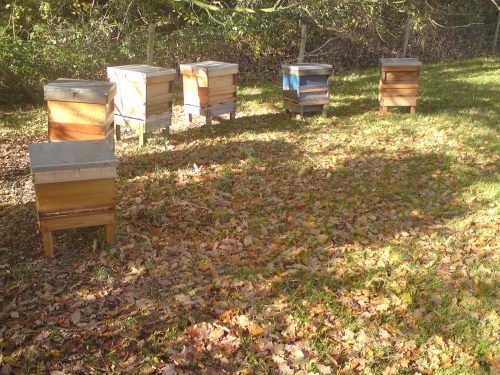
I looked at my six hives a few weeks ago, relieved that they had all made it through the winter.  However, Patience was not laying.

When I looked again a few days ago, Patience had vanished!

This colony collapse thing is hard to understand.

Still, we have five remaining – three of which should produce honey, providing we get through the swarm season without losing a swarm from each.

All the joys of beekeeping!

Read Full Post »

I met an interesting lady on the aeroplane today who told me that her mother kept bees on the Island of Jersey.

When the bees started to swarm, her mother used to tell all her children (she had eight!) to run into the garden with pots and pans and bash them as hard as they could and make as much noise as they could, so that the bees would settle and not fly away.  Her mother would then gather the bees up and put them back in the hive.  She said it really worked.

I said I was not sure if the bees would naturally go back into their old hive if they have swarmed….to which she said that maybe her mother put them in a new hive.

There is a technical word for this banging of pots and pans – which is called “Tanging” – a descrption of which is in Simon Buxton’s book – The Shamanic Way of the Bee.

I also found this older reference:

Engraving from Dutch book

Above is a plate from a Dutch book showing tanging.

“In this late 17th-century engraving from a book printed in Amsterdam, a swarm can be seen coming out of one of the straw hives or ‘skeps’ in the middle of the picture. A beekeeper stands to the right and hits what looks like a metal pan or drum in a procedure known as ‘tanging’. Tanging would alert the neighbourhood that bees are swarming and its rhythmic sound would help coax the bees into the overturned hive in the foreground. This empty hive would also have been lined with honey in order to entice the bees to take up residence within it”

“Tanging was also a way for a beekeeper to alert other beekeepers that a claim was being made on a found swarm. Acquiring new bees by laying claim to a swarm was important, as it was routine at this time for beekeepers to asphyxiate their bees with fumes from burning sulphur in order to access the honeycomb safely.”

I am interested to know if any readers have heard of this ritual and any other reasons that beekeepers might do it.

Plate and text in quotation marks from: http://www.nls.uk/moir/tanging.html

Read Full Post »

Firstly, worker bees fly out from the hive in search of nectar-rich flowers. Using its straw-like proboscis, a worker bee drinks the liquid nectar and stores it in a special stomach called the honey stomach. The bee continues to forage, visiting hundreds of flowers, until its honey stomach is full. Within the honey stomach, enzymes break down the complex sugars of the nectar into simpler sugars, which are less prone to crystallization. This process is called inversion. With a full belly, the worker bee heads back to the hive.

Once back in the hive, the worker bee then regurgitates the already modified nectar for one of the hive bees.  The hive bee ingests the sugary offering and further breaks down the sugars. It then regurgitates the inverted nectar into a cell of the honeycomb.  The hive bees then beat their wings furiously, fanning the nectar to evaporate its remaining water content. As the water evaporates, the sugars thicken into honey. Once the honey is finished, the hive bee caps the beeswax cell, sealing the honey into the honeycomb for later consumption.

A single worker bee produces only 1/12th of a teaspoon of honey in her lifetime. Working cooperatively, thousands of worker bees can produce over 200 pounds of honey for the colony within a year.

From: http://insects.about.com/od/antsbeeswasps/f/beesmakehoney.htm

Read Full Post »

Archeologists digging in northern Israel have discovered evidence of a 3,000-year-old beekeeping industry, including remnants of ancient honeycombs, beeswax and what they believe are the oldest intact beehives ever found.

ap_3000yearoldbees

An archeologist examining the remnants of 3,000-year-old beehives found at Rehov. (AP)

The findings in the ruins of the city of Rehov include 30 intact hives dating to around 900 B.C.E., archaeologist Amihai Mazar of the Hebrew University of Jerusalem told The Associated Press. He sad it offers unique evidence that an advanced honey industry existed in the Holy Land at the time of the Bible.

Beekeeping was widely practiced in the ancient world, where honey used for medicinal and religious purposes as well as for food, and beeswax was used to make molds for metal and to create surfaces to write on. While portrayals of bees and beekeeping are known in ancient artwork, nothing similar to the Rehov hives has ever been found before, Mazar said.

The beehives, made of straw and unbaked clay, have a hole at one end of allw the bees in and out and a lid the other end to allow beekeepers access to the honeycombs inside.  They were found in orderly rows, three high, in a room that could have accommodated around 100 hives, Mazar said.

The Bible repeatedly refers to Israel as a land of milk and honey, but that’s believed to refer to honey made from dates and figs – there is no mention of honeybee cultivation. But the new find shows that the Holy Land was home to a highly developed beekeeping industry nearly 3,000 years ago.

“You can tell that this was an organized industry, part of an organized economy, in an ultra-organized city,” Mazar said.

At the time the beehives were in use, Mazar believes Rehov had around 2,000 residents, a mix of Israelites, Canaanites and others.

Ezra Marcus, an expert on the ancient Mediterranean world at Haifa University, said the finding was a unique glimpse into ancient beekeeping. Marcus was not involved in the Rehov excavation.

“We have seen depictions of beekeeping in texts and ancient art from the Near East, but this is the first time we’ve been able to actually feel and see the industry,” Marcus said.

The finding is especially unique, Marcus said, because of its location in the middle of a thriving city – a strange place for thousands of bees.

“This might have been because the city’s ruler wanted the industry under his control,” Marcus said, or because the beekeeping industry was linked to residents’ religious practices, as might be indicated by an altar decorated with fertility figurines that archaeologists found alongside the hives”.

More at: http://www.haaretz.com/hasen/spages/900809.html and other news articles at the time.
Source from Associated Press September 2007.

Read Full Post »

Midwinter Inspection

Today it was 9 degrees Centigrade at 14.00 when I visited the bees for a mid-winter inspection.  It was a lot warmer than the sub-zero temperatures we have have had for  the past few weeks.  One night we recorded -11 degrees Centigrade – the lowest temperature for about 19 years.  Climate change perhaps.  In any case, the bees called.

I was surprise that all six hives were still populated.  On last year’s performance, I expected us to be down to five by now.  Three hives had good food stocks.  Three needed a bit of additional honey.  Luckily we decided in August to keep all our honey for the bees – and not take it off – so I had one super full of honey left to give back to them.  Somehow giving bees honey rather than feeding them syrup or candy felt much better – even if it meant that we have not had any honey from them this year.

Hawkhurst was the weakest – so she got four frames.    This is the hive that I thought might have not managed the over-wintering.  She is still weak – but the good news is that the queen was laying in August…..so there is hope that it will survive and prosper if we get a reasonable spring.

Harmony was also quite low – and got another four of the frames.  She did not take enough feed in September – so will benefit from the extra stores.

Joy, Faith, and Prior’s Heath were all fine. 

The one that surprised me was Grace (all blue hive).  Although she had more than sufficient stores, she was the victim of raiding in the Autumn.  She got two frames….but will need keeping an eye on as she is probably the most vulnerable.  I am not sure how the bees decide which colony is worth raiding – but I don’t particularly want all the good honey being raided – even if it makes other hives stronger.

A good afternoon’s work.  And so encouraging after last winter’s visits to good old Faith!

This intervention should be sufficient to get over the next six weeks.

In line with my naming convention, the swarms that over-winter get renamed as one of the virtues – so from now on:

Hawkhurst becomes Trust and Prior’s Heath becomes Patience.


dsc00626

So we now have, in order from left to right: Trust, Harmony, Joy, Faith, Grace & Patience which I think are a nice set of virtues for the start of 2009.

I wish all readers a happy and virtuous New Year to weather the uncertain times ahead!

Read Full Post »

How a swarm locates a new nest site when less than 5% of the community know the way remains a mystery. Curious to find out how swarms cooperate and are guided to their new homes, Tom Seeley, a neurobiologist from Cornell University, and engineers Kevin Schultz and Kevin Passino from The Ohio State University teamed up to find out how swarms are guided to their new home and publish their findings on October 3rd 2008 in The Journal of Experimental Biology.

According to Schultz there are two theories on how swarms find the way. In the ‘subtle guide’ theory, a small number of scout bees, which had been involved in selecting the new nest site, guide the swarm by flying unobtrusively in its midst; near neighbours adjust their flight path to avoid colliding with the guides while more distant insects align themselves to the guides’ general direction. In the ‘streaker bee’ hypothesis, bees follow a few conspicuous guides that fly through the top half of the swarm at high speed.    Passino and Seeley decided to film swarming bees with high-definition movie cameras to find out how they were directed to their final destination.  

But filming diffuse swarms spread along a 12·m length with each individual on her own apparently random course is easier said than done. For a start you have to locate your camera somewhere along the swarm’s flight path, which is impossible to predict in most environments. The team overcame this problem by relocating to Appledore Island, which has virtually no high vegetation for swarms to settle on. By transporting large colonies of bees, complete with queen, to the island, the team could get the insects to swarm from a stake to the only available nesting site; a comfortable nesting box. Situating the camera on the most direct route between the two sites, the team successfully filmed several swarms’ chaotic progress at high resolution. 

Back in Passino’s Ohio lab, Schultz began the painstaking task of analysing over 3500 frames from a swarm fly-by to build up a picture of the insects’ flight directions and vertical position. After months of bee-clicking, Schultz was able to find patterns in the insects’ progress. For example, bees in the top of the swarm tended to fly faster and generally aimed towards the nest, with bees concentrated in the middle third of the top layer showing the strongest preference to head towards the nest.
 
Schultz also admits that he was surprised at how random the bees’ trajectories were in the bottom half of the swarm, ‘they were going in every direction,’ he says, but the bees that were flying towards the new nest generally flew faster than bees that were heading in other directions; they appeared to latch onto the high-speed streakers. All of which suggests that the swarm was following high-speed streaker bees to their new location.

More at: http://www.physorg.com/news142228088.html

Read Full Post »

Last week we had the Annual General Meeting of our local branch of beekeepers (The Weald Branch, Kent, UK).  The post for Swarm Coordinator came up – and I put my name forward and was voted in!

So all the hard work this year catching swarms might well turn into a walk in the park for 2009!

I am very interested to know anyone (worldwide) who has experience of effective swarm coordination in a local or regional area….I am sure that the whole thing could be done a lot better if we are more creative with the internet and mobile phone technology!

Please post away!

Read Full Post »

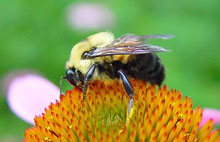
The commercial bumblebees that are brought to greenhouses to pollinate some vegetables occasionally wander off the job, and researchers say the wayward bees that slip out into the fields are infecting their wild cousins with a nasty parasite. A new study says that parasite may be to blame for the recent decline in wild populations in North America and elsewhere [New Scientist].

Greenhouse growers bring in the bumblebees for tomatoes and other crops that need what’s called “buzz pollination,” a strong vibration that shakes loose the pollen. Honeybees don’t give the buzz, but bumblebees do [Science News]. In the study, published in the journal PLoS ONE, researchers observed several greenhouses in Canada, and saw bumblebees flying out of the greenhouses through vents. When commercial bees landed on flowers in the nearby fields, researchers say they left behind parasites that wild bees later picked up. They found that half of the wild bees living near the greenhouses were infected with the parasite, while those that lived farther away were disease-free.

The parasite of concern is Crithidia bombi, which is very common in commercial hives. The parasite robs bees of their ability to distinguish between flowers that contain nectar and those that don’t, [study coauthor Michael] Otterstatter said. For commercial bees fed by their owners, that skill isn’t important. For wild bees, its absence is deadly. “Infected bees make an incredible number of mistakes,” Otterstatter said. “They visit empty flowers again and again” as they slowly starve to death, he said [Bloomberg].

Although the C. bombi parasite doesn’t infect honeybees, whose plight has been in the news as scientists struggle to understand “colony collapse disorder,” researchers say it’s possible that a similar disease relationship exists between commerical and wild honeybees.

The news isn’t all grim for bumblebees: In Scotland, a group called the Bumblebee Conservation Trust has covered an empty field in wildflowers to create the world’s first bumblebee sanctuary. The project has already been an outstanding success, with hundreds of bumblebees buzzing from flower to flower. And to the delight of conservationists, one of the rarest species in the country – the blaeberry bumblebee – has set up home in the 20-acre meadow [The Scotsman].

From: http://blogs.discovermagazine.com/80beats/2008/07/25/commercial-bumblebees-spread-diseases-to-their-wild-kin/

Image: flickr/Clearly Ambiguous

Read Full Post »

“As busy as a bee.”

“What is good for the swarm is not good for the bee.”

“Where there is honey, there are bees.”

“One bee is better than a handful of flies.”

“If you want to gather honey, don’t kick over the beehive.”

“Honey turns sour.”

“The diligence of the hive produces the wealth of honey.”

“A drop of honey will not sweeten the ocean.”

=====================================

The proverbs are from Insect Fact and Folklore , by Lucy W. Clausen. Published by Collier Books, N.Y., 1954.

Read Full Post »

A bee comb has six sides,

on each a magic thing it hides:

Take wax, pollen and a spoon of honey 

which will make you healthy and sunny

Try propolis, royal jelly or venom

and you’ll enjoy bee’s poem!

Adapted from: http://www.bee-hexagon.net/

Read Full Post »

« Newer Posts - Older Posts »