Well the kitchen has been full of the tools for the honey harvest over the past few weeks. With unpacking boxes and extracting and bottling the honey, our lives have been quite busy. We got 113 pounds off – quite a bit more than last year. Of the hives, Faith has come up trumps again, giving us about 5 supers. Hope is no more. The hive was taken over by wasps in August – due to negligence when the move was going on. And Charity seems to have a new lease of life in the past weeks and might survive winter, if only the queen can lay some new brood. A local very experienced beekeeper gave me a great tip about putting back on the hives the extracted supers. Several of the supers went solid. He told me to de-cap the comb and spray it with water. In fact, I left it out for two or three days to capture some moisture – which seemed to have the same effect – and then put them back on the hive on top of a queen excluder below an empty super. The bees think that the gap is not part of the hive and they draw-down the crystallised honey to make winter stores. He said you can also put one frame to allow the bees to climb up. A great way of feeding the bees for winter – though I am not sure if it will bring the queens on laying brood too late in the season. It has been a very mild September so far – so hopefully all will be well. Though Hope is gone, I will re-start her with a new colony next year. Never give up Hope!
Archive for the ‘Beekeeping’ Category
113 Pounds of Honey!…..and How to Convert Crystallised Honey into Winter Stores
Posted in Bee Present, Beekeeping on September 17, 2007| Leave a Comment »
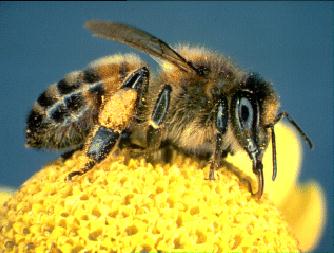
Honey Bee on Flower
Posted in Bee Present, Bee-ology, Beekeeping on August 24, 2007| Leave a Comment »
A New Hive and the Honey Harvest
Posted in Bee Present, Beekeeping on August 24, 2007| Leave a Comment »
Three weeks ago, we moved house……swarmed……for more space. Which is why there have not been many entries in the last few weeks. As a result, the Bees have also not had much attention – though the August honey harvest is overdue. I will visit the hives in the next few days – weather permitting.
The Queenless Hive
Posted in Bee Lore, Beekeeping on August 7, 2007| 1 Comment »
Meanwhile Moscow was empty. There were still people in it, perhaps a fiftieth part of its former inhabitants had remained, but it was empty. It was empty in the sense that a dying queenless hive is empty.
In a queenless hive no life is left though to a superficial glance it seems as much alive as other hives. The bees circle round a queenless hive in the hot beams of the midday sun as gaily as around the living hives; from a distance it smells of honey like the others, and bees fly in and out in the same way. But one has only to observe that hive to realize that there is no longer any life in it. The bees do not fly in the same way, the smell and the sound that meet the beekeeper are not the same. To the beekeeper’s tap on the wall of the sick hive, instead of the former instant unanimous humming of tens of thousands of bees with their abdomens threateningly compressed, and producing by the rapid vibration of their wings an aerial living sound, the only reply is a disconnected buzzing from different parts of the deserted hive.
From the alighting board, instead of the former spirituous fragrant smell of honey and venom, and the warm whiffs of crowded life, comes an odour of emptiness and decay mingling with the smell of honey. There are no longer sentinels sounding the alarm with their abdomens raised, and ready to die in defence of the hive. There is no longer the measured quiet sound of throbbing activity, like the sound of boiling water, but diverse discordant sounds of disorder. In and out of the hive long black robber bees smeared with honey fly timidly and shiftily. They do not sting, but crawl away from danger. Formerly only bees laden with honey flew into the hive, and they flew out empty; now they fly out laden.
The beekeeper opens the lower part of the hive and peers in. Instead of black, glossy bees- tamed by toil, clinging to one another’s legs and drawing out the wax, with a ceaseless hum of labour- that used to hang in long clusters down to the floor of the hive, drowsy shrivelled bees crawl about separately in various directions on the floor and walls of the hive. Instead of a neatly glued floor, swept by the bees with the fanning of their wings, there is a floor littered with bits of wax, excrement, dying bees scarcely moving their legs, and dead ones that have not been cleared away. The beekeeper opens the upper part of the hive and examines the super. Instead of serried rows of bees sealing up every gap in the combs and keeping the brood warm, he sees the skilful complex structures of the combs, but no longer in their former state of purity. All is neglected and foul.
Black robber bees are swiftly and stealthily prowling about the combs, and the short home bees, shrivelled and listless as if they were old, creep slowly about without trying to hinder the robbers, having lost all motive and all sense of life. Drones, bumblebees, wasps, and butterflies knock awkwardly against the walls of the hive in their flight. Here and there among the cells containing dead brood and honey an angry buzzing can sometimes be heard. Here and there a couple of bees, by force of habit and custom cleaning out the brood cells, with efforts beyond their strength laboriously drag away a dead bee or bumblebee without knowing why they do it. In another corner two old bees are languidly fighting, or cleaning themselves, or feeding one another, without themselves knowing whether they do it with friendly or hostile intent. In a third place a crowd of bees, crushing one another, attack some victim and fight and smother it, and the victim, enfeebled or killed, drops from above slowly and lightly as a feather, among the heap of corpses.
The keeper opens the two centre partitions to examine the brood cells. In place of the former close dark circles formed by thousands of bees sitting back to back and guarding the high mystery of generation, he sees hundreds of dull, listless, and sleepy shells of bees. They have almost all died unawares, sitting in the sanctuary they had guarded and which is now no more. They reek of decay and death. Only a few of them still move, rise, and feebly fly to settle on the enemy’s hand, lacking the spirit to die stinging him; the rest are dead and fall as lightly as fish scales. The beekeeper closes the hive, chalks a mark on it, and when he has time tears out its contents and burns it clean.
So in the same way Moscow was empty when Napoleon, weary, uneasy, and morose, paced up and down in front of the Kammer-Kollezski rampart, awaiting what to his mind was a necessary, if but formal, observance of the proprieties- a deputation. In various corners of Moscow there still remained a few people aimlessly moving about, following their old habits and hardly aware of what they were doing. When with due circumspection Napoleon was informed that Moscow was empty, he looked angrily at his informant, turned away, and silently continued to walk to and fro. “My carriage!” he said. He took his seat beside the aide-de-camp on duty and drove into the suburb. “Moscow deserted!” he said to himself. “What an incredible event!” He did not drive into the town, but put up at an inn in the Dorogomilov suburb. The coup de theatre had not come off.
From: (From Leo Tolstoy’s War & Peace: Book Eleven: 1812 – Chapter XX)
Aristaeus: Discoverer of Beekeeping
Posted in Bee Lore, Beekeeping on July 22, 2007| 2 Comments »
In ancient Greek mythology, Aristaeus (or Aristaios) was credited with the discovery of bee-keeping. He was the son of Apollo and the huntress Cyrene. Aristeus (meaning “the best”) became a cult title in many places in the Mediterranean. Which, co-incidentally, is where I was born!
More about Aristeus can be found at http://en.wikipedia.org/wiki/Aristaeus.
On Queen Bees
Posted in Beekeeping on July 21, 2007| Leave a Comment »
There are exceptions to all rules – and I believe that others have found an exception to this rule. But I have not. So far as I am concerned this rule holds true: that there is only one Queen Bee in each Hive. And when there are two queens – such as when a new queen hatches and the old one has not swarmed or thrown a cast, then they will fight to the death. Funny. but I find the female of the human race a bit like that. One Queen Bee per hive. Think about it!
Scout Bees and Preparing to Swarm
Posted in Beekeeping on July 19, 2007| Leave a Comment »
It is a funny feeling moving house after so many years in the same place. So much to do. So many things to sell, pack, or throw away. Just deciding what to do with everything is a challenge. And then you have to think yourself into the new place you are moving to. Where will that table or chair fit? Should I get a new one of those or make do with the old one that is broken? All based on a visit to the new property over six weeks ago when all I had was a notepad and a tape measure and no real idea of what should go where. The bees probably have similar issues. When they swarm, we are told that there are scout bees that go out and find suitable locations for a new home. On the day of swarming the queen and the swarming bees initially take up residence just outside the hive – on a tree or a branch. Then they swarm to their next resting place. Often they will move into a tree or cavity where bees have been before – just like humans. No one is exactly sure why bees swarm when they do. It seems to be for a combination of reasons – but lack of space is definitely one of them. I am not exactly clear why two of my hives (Hope and Charity) swarmed this year – given that they were both new queens last year. Perhaps their scout bees found somewhere better. Like I have done. The new cottage where I am moving to is better and bigger than where I am – though still quite small. And it is the best result from all the scouting I have done in the past year around properties in the South East of England.
On Swarming
Posted in Beekeeping on July 18, 2007| Leave a Comment »
Next week I am moving house. The human equivalent of swarming. The two-bed cottage in Kent, England which I have lived in for the past (nearly) five years has become too small. I started the season with three hives. Two of them have also swarmed this year. Not a sign of good beekeeping! But a fascinating (and lucky) thing to experience. It was a very hot April and Charity (the name of one of my colonies) swarmed very early in the season, requeened naturally and has become very angry. Hope followed in May. The only remaining hive, Faith, has been fantastic and has not swarmed yet – but the recent hot weather (like yesterday’s) – combined with the fact that I have not visited the hives for two weeks – means that I wouldn’t be surprised if Faith has also swarmed. I re-queened Faith in September 2005 with a queen from Basingstoke. She was very strong last year (producing over 100lbs of honey) and has been equally strong this year (set to produce a similar amount). The other hives have requeened themselves and have been much less predictable and productive. Just like in Business, really. Strong team leaders produce much more than average or randomly selected team-leaders. Strong (well-bred) team leaders will give consistent service. They will also be loyal (to a point) and are less likely to swarm. The analogies are very interesting and I will go into more detail in future postings.
 Bee Lore