Feeds:
Posts
Comments

Archive for the ‘Bee Present’ Category

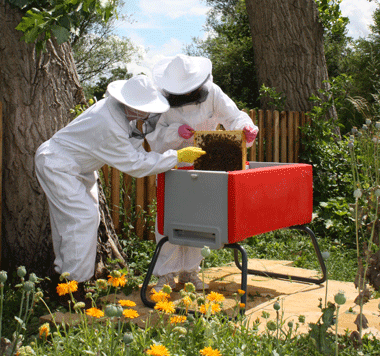
Here is another interesting design – which has the same frame size for both the brood chamber AND the supers – the Rose Hive OSB (one-size box).  As well as having the same sized boxes for brood chamber and super, it also has no queen excluder!  The other advantage is that the roof and floors are National sizes – so for those with existing hives, many parts can be reused in the Rose OSB system without having to buy new rooves, floors or stands.

Graphic2c

I think this is a really neat idea.  It means that the queen is free to roam the whole hive and brood comb is not constrained.  And the problem of having not enough drawn comb for the brood chamber simply vanishes – because all drawn comb can be moved around depending on what the bees need – and there is no build-up of old black comb which can encourage varroa and wax moth.

rose hive

The only downside seems to be that the supers are more heavy than the conventional National / Commercial bee hive – but I tend to use a wheelbarrow when it is harvest time – which takes a lot of the back pain away.

Thornes (in the UK) are apparently selling the Rose Hive.  I am very interested in trying this new system – as well as having any comments that anyone has on how successful it has been for them – or any other observations they might have on it!

More at:  http://www.rosebeehives.com/index.php

Read Full Post »

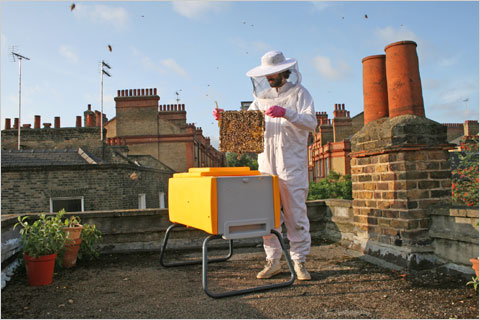
A friend of mine has just sent me an interesting link for a new type of hive.  It is based on the Dartington long hive – but is made of plastic.

ps_beehaus_buzzworks

Seems a good idea for beginner beekeepers or urban beekeepers (see below) – though I have not tried the system and cannot comment on how good it is.  My friend has a Dartington hive and says that it will have advantages over her current hive because the new plastic roof will weather better than the old design which is based on plywood.

10greeninc.bees

Interestingly enough, the number of beekeepers in my local area has increased by 100 to about 650 – and I am told that the number of new beekeepers in the county has increased more this year than for any other year since the 1940s!  This new design will surely attract more beekeepers in the UK.  I hope so!

More at:  http://www.omlet.co.uk/products_services/products_services.php?view=Bees

Read Full Post »

Thanks so much, Sylvia, for leaving such a beautiful story on the site:

Many years ago, there was an argument between my living-partner (and best friend) and a neighbour who owned the large orchard opposite us.  My friend, quite erroneously I believe, accused him of things he had not done. I could not sway the argument no matter what I did!

A bee came on to my hand one day.  It rested a moment, then vibrated its wings for take-off.  I asked it to help.  I asked the Bee Soul to help.  I knew it would happen.  I also asked for a ’sign’.

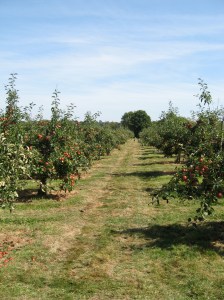
Avenue of Apple Trees in an Orchard

Avenue of Apple Trees in an Orchard

A few days later my friend came home and said he had made it up now with the orchard owner.  They had met in town and decided they were both too old and grey to be fighting like this about silly things.  My friend had been invited to tea there.  He came home an hour or so later.  He was smiling.  He told me the orchard owner had taken him to visit his hives (I did not know the man kept bees!)  He had given him a gift.  A pot of honey.  He had said: “Some of this honey must have been made from the flowers in your garden!”

Read Full Post »

I turned 50 last month and never posted anything.  I had a good party and caught a swarm of bees on the day!

I came across this piece by Carl Jung which somehow encourages me that there is still more to learn, uncover and grow towards in the “afternoon of life”:

“Wholly unprepared, we embark upon the second half of life . . . we take the step into the afternoon of life; worse still we take this step with the false assumption that our truths and ideals will serve as before. But we cannot live the afternoon of life according to the program of life’s morning — for what was great in the morning will be little at evening, and what in the morning was true will at evening have become a lie.”

Read Full Post »

I have always been fascinated in Heraldry – ever since I was sent away to a boarding school in Windsor.  Every Sunday during termtime we had to go to the Chapel of St George in Windsor Castle to sit through two services – Mattins and Evensong.  I was not a chorister.  I was a “super” which, in Latin means “extra”.  A bit like a drone, really.  The only thing to look at in the Chapel were the shields and banners of the Knights of the Garter that hung on the walls.  Very romantic.  So many colours, patterns, symbols.  This combined with the beautiful singing had a very calming effect.  Even now, if I want to relax, I will listen to medieval choral music.

It is probably not so surprising that:

The bee is the most popular insect in Heraldry

The bee is normally shown with an old-style beehive – as shown on the shield above.

More at: http://www.heraldryandcrests.com/heraldic_symbols.htm

Read Full Post »

I came across this video on the internet.  Wow, for a simple English word “bee” the way of describing it in the Chinese symbols is so artistic.  There are two words, each with a picture and a word to pronounce.

None of the character actually looks like a bee.

Think I will stick to English for the moment!

More at: http://www.ehow.com/video_4403826_write-bee-chinese-symbols.html

Read Full Post »

On Sunday, I got a very unexpected email and phone call!  It was from the man who told me about the last swarm that I caught (see the blog entry about catching a swarm in 15 minutes).  He had another smaller swarm (which turned out to be a cast).  And it was in EXACTLY THE SAME PLACE!

I went round on early Monday morning and scooped the cast into a box.  It was raining and the bees clung to each other like treacle.  Because I had done it before – and the bees were so accessible, I think this time it took even less than 15 minutes!  Probably more like 10!

Anyway, Monday was a rainy day and that evening we returned to pick up the nucleus box.

This morning, I met up with an old friend and gave her the cast as her (only) hive had gone queenless.  When she put the cast into her hive (she has a Dartington Long Hive with two sides to it) – she found that the colony was no longer queenless but that the queen has started laying.  Oh well!

Read Full Post »

The other night I was rung by a local who had a swarm of bees just outside his house in a newly planted Hawthorne Tree.  Trouble was that I was going up to London half an hour later!  So I only had about 15 minutes to catch the swarm.  But I gave it a go.

When I arrived, the swarm was beautiful – quite large and very settled!  Here is a picture of it:

Swarm at Court Lodge 28 May 2009

It was about 17.00 when I started this.  If it had been 20.00 it might not have been as effective.

I put a large sheet on the ground under the tree and then held a nucleus box made from plywood with four frames of foundation under the bottom of the swarm.  I sprayed the bees with water and with my right hand I gently swept the hanging bees into the box.  About half fell in – including, I suspect, the Queen.  There were a few bees on the ground which I gently put into the box.  The lid then went on the box.

I asked the owner for a chair and put the box on the chair with the sheet between the box and chair so that the bees could climb up the sheet into the box.

I finally shook the tree about twice to get the final bees off the tree and into the air.

Whole process took 15 minutes.  When I rang the owner of the tree at 18.00 and most of the swarm was in the box.

At 08.00 the next morning, I picked up the box and took it back to the apiary.  Very successful!  Five swarms in May with still a few more days of sun that might produce another one or two!

I find the most useful equipment for catching a swarm is:

a)  a plywood nucleus box with about 4 frames (not six) so there is a bit more space if you are going to knock the bees into the box

b)  a sheet from a double bed that can go on the ground so you can see where the bees have dropped – as well as giving the bees something to climb up into the box if they are too weak to fly.

c)  a chair or stool to put the swarm on (if you can’t put the box back on top of where the bees where originally)

d)  a water sprayer (optional) – I used water this time and liked it as the bees get less stressed with water than if you use smoke.

Read Full Post »

A great video on YouTube that gives the Lifecycle of the Honeybee:

http://www.youtube.com/watch?v=sSk_ev1eZec

Read Full Post »

When visiting the apiary yesterday I noticed a beautiful white cobweb glistening in an apple tree about 10 metres from the hives.  As I drew closer, I saw it had a cuttlefish-like structure.

On closer inspection it turned out to be a piece of pure white honeycomb – about 5 inches long by 4 inches wide that had obviously been drawn out by one of the swarms from the apiary earlier in the month.  It was not the yellow comb you get in older hives.  It had no pollen, honey and certainly no sign of the darkened cells you get from the queen laying eggs.

It was quite beautiful.  Pure virgin white.  I took it home and put it on pride of place on the mantlepiece!  I wonder if it will go yellow over time?

Read Full Post »

« Newer Posts - Older Posts »