Feeds:
Posts
Comments

Archive for the ‘Bee Present’ Category

Whenever I visit my hives I come away feeling much calmer.  Non-beekeepers are often amazed when I say this.  They assume that I would become more stressed with the “threat of the sting”.

But the inverse is true.  After my seasonal dosage of stings which occur naturally when beekeeping, any stings after them become little more than a pin-prick.  This was true even at the height of the stinging season last July when I had two very buzzy hives and (rather stupidly) opened both up the same afternoon at the end of an inspection.  They managed to sting me through my suit at least 20 or so times!  The effects were that, overall, I felt better, not worse!

No, the threat of the sting is not a problem.  But the calming effect is intriguing.  And I have a feeling that, apart from a sort of bee-sting-therapy, it is the actual vibrations that the bees give off that helps to create this overall calming effect.  I have discussed this idea with other beekeepers – and none has yet disagreed.
This is definitely one of the areas that has to do with “beetwixt and between” – especially for those of you interested in the non-physical aspects of  bees and beekeeping.  Yet the research seems to be fairly scant.  Or maybe I simply have not yet come across it?!

So, to celebrate the coming of the new year, I intend to write a number of casual posts on the theme of Bee Vibrations.

Hope you enjoy and keep buzzing good vibrations for the rest of the year!

Photo from: http://www.ace-clipart.com/

Read Full Post »

A very happy New Year to all readers and to all the Bees!

It snowed again today.  So we huddled up next to the fire and looked back at some of the photographs from the summer.

Here is one of my favourites where we caught two bees visiting a water lilly at a nearby lake.

Hope you enjoy it!

Happy if you want to use this picture yourself, so long as you refer back to this page, please!

Read Full Post »

What a strange world it is.  I met up this year with someone who I had not seen for a few years – Andrew Gough.  Andrew and I used to work together – yet we both have websites showing our passions – and they overlap with bees.

You can find our mutual interest at Andrew’s (much better laid out – in fact, beautifully constructed) site at:

http://www.andrewgough.com/bee1_1.html

Read Full Post »

There is an old tale from Scotland and the North of England that the bees buzz at midnight on Christmas Eve.  They have been doing it for centuries, apparently!

I visited my hives today – but all was quiet!  Then again, I did not visit them at midnight!

There was lots of snow, though!

A merry Christmas and successful New Year to all readers!

Read Full Post »

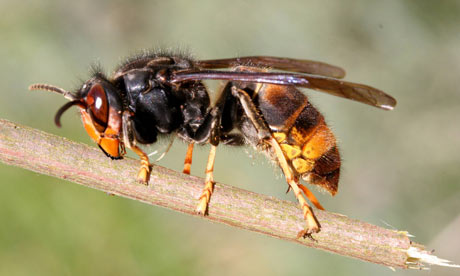
For five years they have wreaked havoc in the fields of south-western France, scaring locals with their venomous stings and ravaging the bee population to feed their rapacious appetites. Now, according to French beekeepers, Asian predatory hornets have been sighted in Paris for the first time, raising the prospect of a nationwide invasion which entomologists fear could eventually reach Britain.

Asian-predatory-hornet-Ve-001

The Asian predatory hornet, Vespa velutina. Photograph: Jean Haxaire/AFP

More at:  http://www.guardian.co.uk/world/2009/sep/25/predatory-hornet-sighting-paris-france

Read Full Post »

Honey sales in Kuwait rose 20 percent last month as people concerned about the spread of swine flu attempted to boost their immune system naturally.

Traditional medicine expert Youssef Al-Faresi told KUNA news agency that people were taking honey to ward off the H1N1 virus because of a lack of official vaccines.

“Honey is commonly known for its stigmatisation of the antibodies; it is useful for schoolchildren who could get in touch with swine flu patients,” he said.
More at: http://www.arabianbusiness.com/567106-kuwait-honey-sales-rise-on-swine-flu-fears

Read Full Post »

From Friday 4 September 2009 to Sunday 6 September 2009 from 12noon – close, there is a”Bee Social” going on as part of the Pestival weekend on the Southbank in London – to celebrate with the bees as the summer draws to an end.

For one weekend only, Pestival is going to transform The Front Room at Queen ‘Bee’ Hall into a giant bee hive, a place for all to learn and discuss the colony collapse disorder. Come listen to the talks, discussions as well as a special duet performance by the Royal Festival Hall’s resident bees with guest peformers.

beecab

Programme includes:
Robyn Hitchcock’s launch night on Friday 4 September spills out into The Front Room for an extended DJ set and party. Thick La Cucaracha meets Maggot from Goldy Looking Chain. Strict dress code: masks, wings and antennae!

Talkaokie who leads a round table discussion and where bee specialists are on hand to explain the plight of bees and do demonstrations. (Saturday & Sunday, from 12pm – 2pm and 4pm – 7.30pm)

Susanna Soares will showcase her pavlov’s bee device, beautiful in construction and useful tool In predicting health problems. Bees have a phenomenal odour perception. They can be trained within minutes using Pavlov’s reflex to target a specific odour and their range of detection includes pheromones, toxins and disease diagnosis. (Saturday and Sunday  at 2.30pm and 3.30pm)

North London Beekeepers who are on hand to give urban bee keeping advice. (Saturday & Sunday)

LottoLab’s The Bee Matrix, a unique exhibit of glass, light and bumblebees – part science experiment, part sculpture – to demonstrate the role of history in shaping visual behaviour. Lottolab will be on hand to engage people in their research a project Seeing Bees See. (Saturday & Sunday)

Dr. Rufus Cartright, beekeeper Steve Benbow and a group of school children who present research findings from their BeeCab summer bee/pollen pollution project. (Saturday & Sunday)

Le Suisse Marocain, a Parisian carnival artist who, in keeping with the tradition of the unknown in the ‘Old Masters’ category, calls himself ‘Le Suisse Marocain’. The role he has chosen for this is that of the artist-as-clown, and over the festive period, he paints a live mural inspired by bees in The Front Room. Come along and watch the artist create his living work.  (Saturday & Sunday)

Plus many more performances on the Larvae Stage.

More at: http://www.southbankcentre.co.uk/calendar/productions/bee-social-113f

Read Full Post »

Flowers of a given species all produce nectar at about the same time each day, as this increases the chances of cross-pollination. The trick works because pollinators, which in most cases means the honeybee, concentrate foraging on a particular species into a narrow time-window. In effect the honeybee has a daily diary that can include as many as nine appointments — say, 10:00 a.m., lilac; 11:30 a.m., peonies; and so on. The bees’ time-keeping is accurate to about 20 minutes.

Honey bee nectaring on button willow

Honey bee nectaring on button willow (from NY Times article cited below)

The bee can do this because, like the plants and just about every living creature, it has a circadian clock that is reset daily to run in time with the solar cycle. The bee can effectively consult this clock and “check” off the given time and associate this with a particular event.

Honeybees really are nature’s little treasures. They are a centimeter or so long, their brains are tiny, and a small set of simple rules can explain the sophisticated social behavior that produces the coordinated activity of a hive. They live by sets of instructions that are familiar to computer programmers as subroutines – do this until the stop code, then into the next subroutine, and so on.

These humble little bees have an innate ability to work out the location of a food source from its position in relation to the sun. They do this even on cloudy days by reading the pattern of the polarization of the light, and pass this information to other bees. In the dark of the hive, they transpose the location of a food source in the horizontal plane through the famous “waggle” dance into communication in the vertical plane of the hive.

Honeybees can tell their sisters how far away the food is up to a distance of about 15 kilometers. For good measure, they can also allow for the fact that the sun moves relative to the hive by about 15 degrees an hour and correct for this when they pass on the information. In other words, they have their own built-in global positioning system and a language that enables them to refer to objects and events that are distant in space or time.

German scientists in the early part of the last century called this ability of bees to learn the time of day when flowers start secreting nectar and visit the flowers at appropriate times Zeitgedächtnis, or time-sense. But the species of flowers in bloom, say, this week, is likely to be replaced by a different species at a different location next week or the week after. The bee needs a flexible, dynamic appointments system that it continually updates, and it has evolved an impressive ability to learn colors, odors, shapes and routes, within a time frame, quickly and accurately.

More at: http://judson.blogs.nytimes.com/2009/04/28/guest-column-lets-hear-it-for-the-bees/?ref=opinion

Read Full Post »

Two years ago last month this blog started.  I continue to be amazed at how many people visit the site.  This year has also been quite extraordinary – having caught about 8 swarms of bees.  We now have a total of nine colonies.  Quite an increase from single old Faith at the start of 2008!

The local government bee inspector rang me last week and asked to inspect my hives (for the second time this year) so he could take samples of bees from five of my hives.  Unfortunately I had to go to town that day, so I did not accompany him on the inspection.  But all was well.  Only Joy is Queenless.  The remaining eight hives are doing well – though there was not as much honey as I was hoping for as July was quite wet.

A little over a year ago I stopped working at the corporate grindstone and the last year has been interesting – with my attention being turned to smaller companies and more local initiatives with my new company, Objective Designers.  More at: www.objectivedesigners.com

Last year I was wondering why Tears of Ra, the Sun God (https://beelore.com/2007/08/24/tears-of-ra-the-sun-god) is the most popular page by far.  Someone told me that there is an American TV series called Stargate Atlantis where RA is one of the main characters.  Perhaps that is one of the reasons for the page’s popularity. Interested to know if anyone else has other theories.

My most favourite story was the one I posted in July (https://beelore.com/2009/07/21/a-gift-from-the-bees/).  I would love to have more stories like this to post.  Please do send me any stories from your past or ones you have heard of so they can be posted!

So what plans for beelore in the coming year?

I have finally started to write more on the Bylaugh story (https://beelore.com/category/bylaugh/)…..which is beginning to turning into a book about the practical and spiritual side of beekeeping as well as research the connection between the health of bees and the state of the planet.  I want this to be multi-media – perhaps eventually making a film or a series of videos.  I also want to use some of the material to create a course for beginners in beekeeping.  I think that there is so much about bees that can be taught alongside the basics side of practical beekeeping.  And this site will continue to collect that type of material.  So all contributions are welcome!

Read Full Post »

Bees and Drums

What do bees have with do with drums?

In the case of the kundu (pictured below), which is a traditional drum from Melanesia, bees play an important role in the construction of the drum.

A kundu

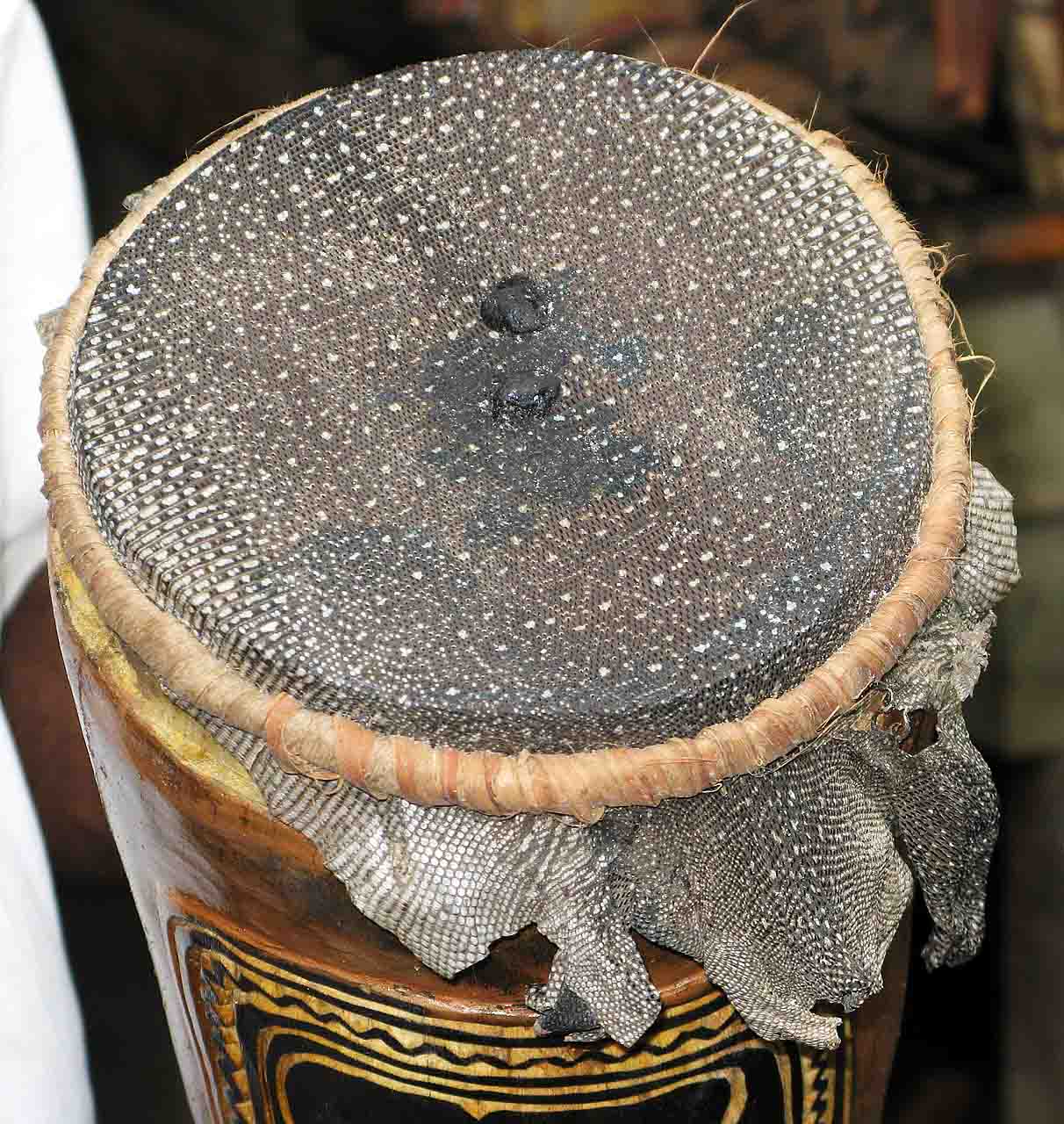
Here is a close-up picture of the head of the drum:

The head of a kundu drum

The head of the drum is made from lizard skin. Although this is unfortunate for the lizards, the skin is tough and durable.  It is held in place by the fibre ring that you can see surrounding the head of the drum.

Like all drums, the resonant frequency of the kundu is very important: it must sound just right to be in tune with other musicians that might want to play at the same time.  Most drums are tuned by adjusting the tightness of the drum head material with strings or clamps.  But with the kundu drum, they use something else.  If you have a look at the photo above,  you will find a clue.  And this is where the bees comes into the story:

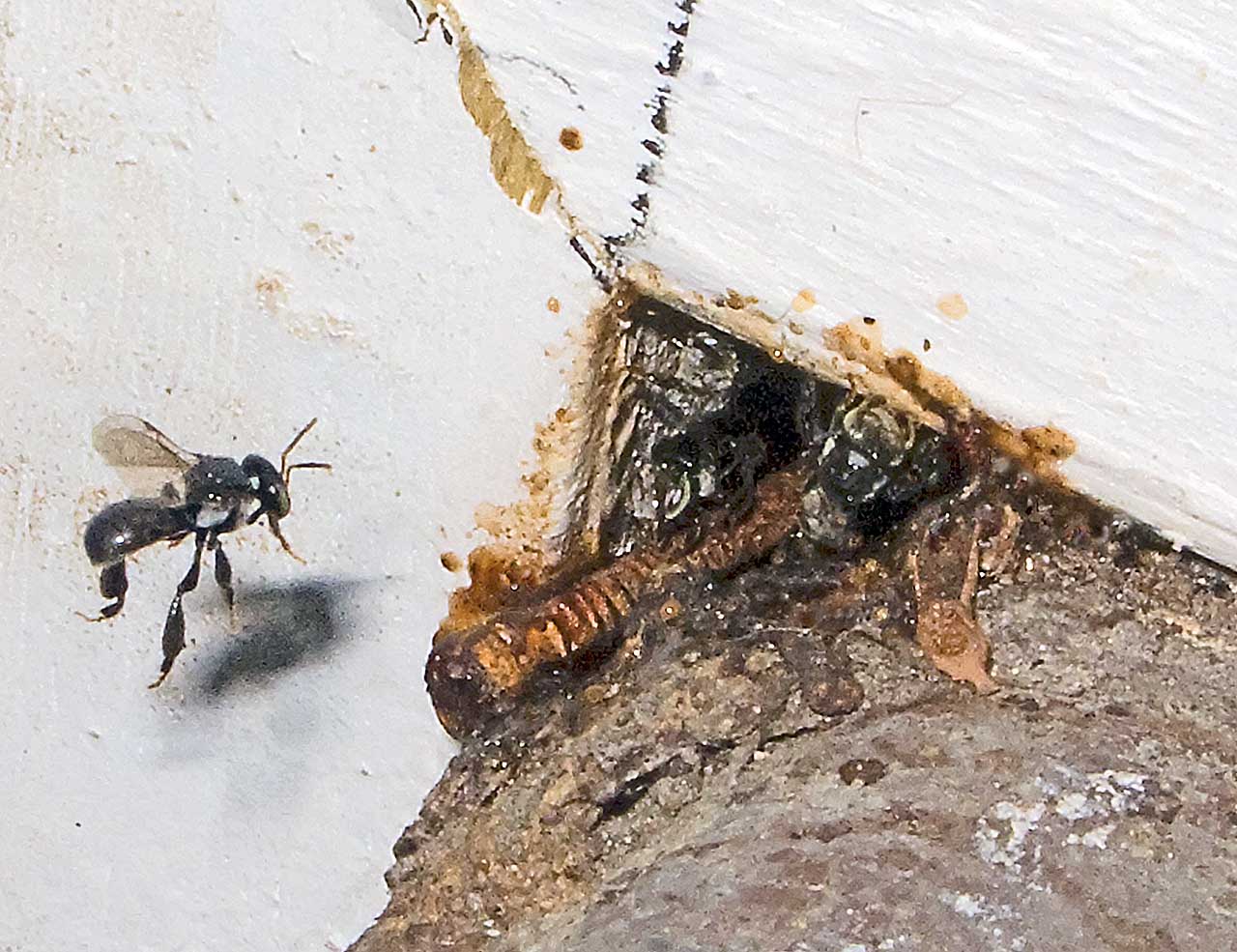
The bee that allows the kundu to be tuned

The drum-makers usually make dark little globs which they put on the drum skin from an incredibly sticky beeswax obtained from the hives of the little bee above. There are also other materials that are used for tuning.  (In fact the globs on the kundu above are not beeswax at all. They are made from some gooey substance derived from breadfruit – but it makes for a good story about bees!)

By adding mass to the head of the drum, the resonant frequency is lowered. You can adjust it only downwards by adding mass, so you have to start out by stretching the skin very tightly to get a frequency higher than you want. Then you add the mass of the beeswax a little at a time until it is just right.  If the frequency is too low, the drummer holds the head of the drum near the flames of the fire to tighten the head and raise the frequency.

Which is one way that bees are connected to drums!
Main idea and pictures from: http://www.messersmith.name/wordpress/2008/10/drums-and-bees/

Read Full Post »

« Newer Posts - Older Posts »