Feeds:
Posts
Comments

Archive for the ‘Bee Present’ Category

“Our treasure lies in the beehive of our knowledge.  We are perpetually on the way thither, being by nature winged insects and honey gatherers of the mind.”

Quotation  from the Preface to  “The Genealogy of Morals” (written in 1887) by Friedrich Nietzsche the German philosopher – who lived from 1844 to 1900.

What a lovely analogy – “honey gatherers of the mind!”  Nietzsche died well before the invention of the internet – which, by his analogy has surely now become a truly magnificent “beehive of our knowledge”.   And how quickly the honey gathering of the mind has accelerated with all the search engines, blogs and wikis that are now available to us.  Even more reason for us all to find the hidden treasure of the secrets of life that the bees have known for so many millions of years!

Read Full Post »

I am fascinated by the Ancient Traditions of the Melissae and found this on the web:

Artist Statement by Nancy Macko

‘My last major piece was an ambitious installation entitled Dance of the Melissae, a multi-sensory, multi-media body of work that explored the world of the honey bee society and its relationship to art, science, technology and ancient matriarchal cultures. This piece was exhibited at the Brand Library Art Gallery in Glendale, California in 1994. The 3,000 square foot space lent itself well to my ideas for creating a multi-sensory construction of an ancient and sacred site and its interior components. The integration and centralization of bees and bee worship by ancient matriarchal cultures are historical testament to the power and fascination of the astounding world of bees.

Borrowing images from nature and bee society, I attempted to reveal the inherent connection between the natural world and technology. The piece incorporated mixed-media wall reliefs, found-object sculptures and computer-generated photographic images installed together and linking traditional media (drawing, painting, printmaking and sculpture) with the more contemporary world of digital media. From a conceptual base that is framed by feminist thought, I am using the “bee” and the “honeycomb” as metaphors to re-interpret scientific ideas. My intention is to suggest that science is based not only on observing nature’s structures but also on imagining them.

“The exhibition thus becomes an investigation of the Enlightenment from the perspective of the practitioner; Nancy Macko’s critique of the information world suggests a Kuhnian paradigmatic shift in which technology becomes ritual, science reverts to magic and art is removed from the site of culture and comes back to life.” (J. M. S. Willette, “How Sweet It Is,” Artweek, February 17, 1994.)’

I’m not exactly sure what this Kuhnian paradigmatic shift is – but you can find out more on Nancy Macko’s work at: http://www.cla.purdue.edu/waaw/Ressler/artists/mackostat.html

See also: http://www.nancymacko.com/ about Nancy Macko’s exibition on LA a year ago – including a wall of hexagons – none of which I saw, unfortunately.  But I think her art and interpretation of the bee lore and feminism is fascinating!

Read Full Post »

Can be found at:

http://www.metacafe.com/watch/966650/john_cleese_and_rowan_atkinson_beekeeping/

Read Full Post »

Then the veiled angel lit a match and put it into the can she was holding.  The “smoker” started smoking.  She squeezed a small contraption on the end of the can and smoke appeared from the nozzle.  She said at me in her low, chanting voice: “It reminds them of a forest fire and although they are drowsy, they will move away from the smoke and into the box”.  Very slowly, very gently she started puffing small bursts of smoke onto the bees so that they melted uphill into the box, just as honey might melt from a spoon into a jar – only against gravity!  Perhaps it was like honey would flow if you were pouring it in a spaceship – though I didn’t suppose that honey was a sensible food to take on a spaceship!  “We need to find the Queen”, she said.  After about ten minutes the medicine ball was down to the size of a football. It was then that she said “There she is!  Once the Queen is in the box the rest of the swarm will follow very quickly. The worker bees are in love with her smell.”  She was quite right! Once the Queen had been smoked into the box, it only took another few minutes before the last remaining bees moved much more quickly to follow her. Overall the exercise took about twenty minutes. Incredible, since the whole swarm had landed on the fence in about forty five seconds.

Read Full Post »

She went back to her box, picked it up and can and then carried it slowly up to the swarm.

And she started speaking in a low voice.  It was almost like singing.  Her hands were bare, yet the rest of her body was covered in white.  I did not understand this, because I though that the one place which the bees would sting her would be on her hands. The barrage of questions rushed back into my mind:

“Are they wild bees – or domesticated bees?”
“How many times have you done this before?”
“What was the most dangerous bee catching job you did?”
“How many hives do you have back in your home?”
“How long have you been keeping bees?”

But I never asked her any of the questions because she was too concentrated in talking to the bees!

Read Full Post »

By William Butler Yeats

I WILL arise and go now, and go to Innisfree,
And a small cabin build there, of clay and wattles made:
Nine bean-rows will I have there, a hive for the honey-bee,
And live alone in the bee-loud glade.

And I shall have some peace there, for peace comes dropping slow,
Dropping from the veils of the mourning to where the cricket sings;
There midnight’s all a glimmer, and noon a purple glow,
And evening full of the linnet’s wings.

I will arise and go now, for always night and day
I hear lake water lapping with low sounds by the shore;
While I stand on the roadway, or on the pavements grey,
I hear it in the deep heart’s core.

From: http://www.online-literature.com/yeats/775/

Picture from: http://mfinley.com/gif/innisfree.jpg

Many people, both past and present, find places of sanctuary where the bees are!  It is sometimes difficult to know what comes first – the bees or peaceful places.  But put the bees in a peaceful, tranquil spot near water and the peace passes all understanding!

Read Full Post »

muhammadali.gif

Quoted by Mohammad Ali.

This is a graphic image on Mohammad Ali’s technique on how to box.  Isn’t it strange how we need to refer to the insect kingdom (and not the kingdom of mammals) to describe the extremes of grace and power!

Picture from: http://theknightshift.blogspot.com/2007_01_01_archive.html

Read Full Post »

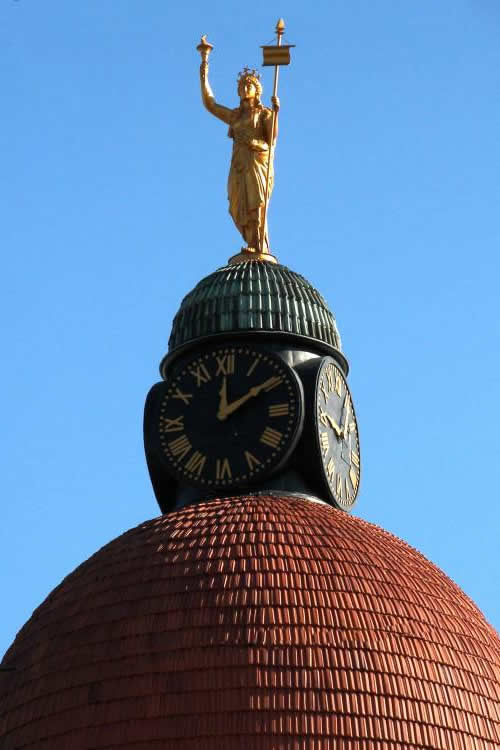
The genetic blueprint of the honeybee was published in 2006.  It revealed surprising links with mammals, including humans. 

Honey bees apparently have an internal “biological clock” which is more like those of mammals than of flies, the research has revealed.  The clock governs many activities, including time sensing, navigation, labour division, and the famous bee “dance language” which the insects use to communicate information about food sources.

Facts from: http://news.bbc.co.uk/1/hi/sci/tech/6084974.stm

Picture of Bee County Courthouse, Texas, USA from: http://www.texasescapes.com/SouthTexasTowns/BeevilleTx/BeevilleTxBeeCountyCourthouseDome1206BarlcayGibson.jpg

Read Full Post »

In 2006, scientists identified the oldest known bee, a 100 million-year-old specimen preserved in amber which was found in a mine in northern Myanmar (Burma).

Oldest bee

More at: http://news.bbc.co.uk/1/hi/sci/tech/6084974.stm

Read Full Post »

Bees are often considered a symbol of the Goddess or Divine Feminine because they are ruled by queens. In particular, they are associated with the goddess Venus because part of their labor is the indirect fertilization of flowers, all of which come under the dominion of Venus.

Without bees, many species of flowers would die out, and so the bee may justly be considered a handmaiden of that goddess. There is a Greek tradition, too, of the Nine Muses, the divine patronesses or music and poetry, taking on the form of bees. This comports well with the rulership of Venus over the arts.

From: http://www.polarissite.net/page26.html

See also my entry on Aphrodite/Venus: https://beelore.com/2008/01/20/the-melissae-and-aphrodite-in-ancient-greece/

Read Full Post »

« Newer Posts - Older Posts »