Aerodynamically, the bumble bee shouldn’t be able to fly, but the bumble bee doesn’t know (the laws of aerodynamics), so it goes on flying anyway!
After Mary Kay Ash American businesswoman who founded Mary Kay Cosmetics (1963). b.1915
Posted in Bee Law, Bee Lore, Bee Present, Bee-ology on November 11, 2007| Leave a Comment »
Aerodynamically, the bumble bee shouldn’t be able to fly, but the bumble bee doesn’t know (the laws of aerodynamics), so it goes on flying anyway!
After Mary Kay Ash American businesswoman who founded Mary Kay Cosmetics (1963). b.1915
Posted in Bee Lore, Bee Present, Bee-ology, Beekeeping, Beetwixt & Beetween on November 9, 2007| 1 Comment »
Eddie: Say, was you ever bit by a dead bee?
Beauclerc: I have no memory of ever being bitten by any kind of bee.
Slim: Were you?
Eddie: You’re all right lady. You and Harry’s the only one that ever—
Harry: Don’t forget Frenchy.
Eddie: That’s right. You and Harry and Frenchy. You know you gotta be careful of dead bees, if you go around barefooted. Cause if you step on ‘em they can sting ya just as bad as if they was alive, especially is they was kinda mad when they got killed. I bet I been bit a hundred times that way.
Slim: You have. Why don’t you bite them back?
Eddie: That’s what Harry always says. But I ain’t got no stinger.
===============================================
From: “To Have and Have Not” (1944).
By: Jules Furthman (1888–1960), U.S. screenwriter, William Faulkner (1897–1962), U.S. author, screenwriter, and Howard Hawks.
With: Eddie (Walter Brennan), Beauclerc (Paul Marion), Slim/Marie Brown (Lauren Bacall), Harry Morgan (Humphrey Bogart)
By answering Eddie’s nonsensical question correctly, Slim earns entree into Harry’s and Eddie’s tight-knit group.
===============================================
I once met a beekeeper who said it was possible to inject sufferers of arthritis with stings from dead bees to help ease the ailment. However, I have never tried it! Odd as it seems, dead bees can sting you – particularly if , like Eddie, you tread on hundreds of them with bare feet!
Posted in Bee Present, Bee-ology on November 9, 2007| Leave a Comment »
Along the garden-wall the bees
With hairy bellies pass between
The staminate and pistillate,
Blest office of the epicene.
T.S.Eliot (1888-1965)
======================
I love this short poem by Eliot.
It articulates the relationship between bees and flowers in such elegant, simple and poetic language.
Posted in Bee Law, Bee Lore, Bee Present, Bee-ology, Beekeeping, Beetwixt & Beetween on October 19, 2007| Leave a Comment »
“Most of the bees come to their end in the open fields. With wings frayed from the winds the summer workers reach the limit of their strength and expire. Bees that die within the hive are carried outside by the workers – yet this is a rare occurrence. As many observers have reported, dying bees will use their last remaining strength to creep beyond the landing board. A Law of the insect city apparently leads the exhausted bees to leave the interior of the hive and so save their fellow workers the task of removing their bodies. The queen seems to be guided by the same instinct, leaving the hive when her end is near. For cleanliness is one of the unwritten laws of the insect city. It is inherent in the bees. ”
From: ‘The Golden Throng’ by Edwin Way Teale – republished by Alpha Books of Dorset in 1968.
Posted in Bee Present, Bee-ology, Beekeeping on September 17, 2007| Leave a Comment »
A queen bee, the mother of all bees in the hive, will lay an average of 1500 eggs in a day!
Posted in Bee Lore, Bee-ology, Beetwixt & Beetween on August 24, 2007| 18 Comments »
According to one ancient egyptian myth, honey bees were the tears of the sun god Ra. In this context, the bee was seen as the messenger of the gods, falling down, like tears, towards the earth (and man) to pass on some secret message.
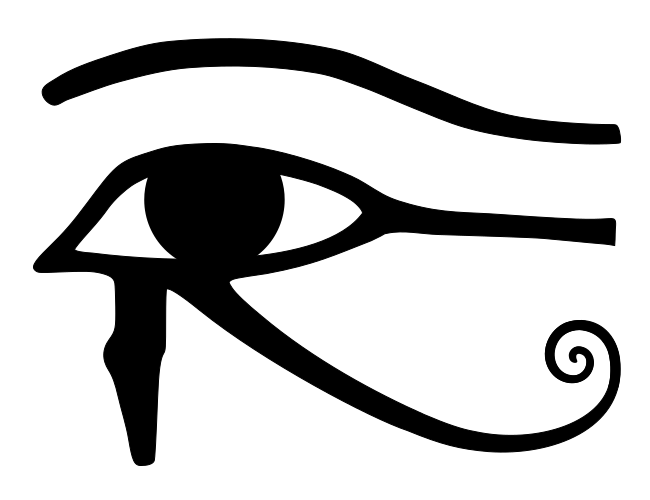
The above symbol was called the Udjat in ancient times. It is now more commonly called the Eye of Ra or Eye of Horus and represents the right eye of the Egyptian Falcon God Horus and was also associated with the Sun God Ra. It is supposed to be where the tears (or bees) came from.
According to another legend, the left eye was torn from Horus by his brother Seth. It was magically restored by Thoth, the God of Magick. After the restoration, some stories state, Horus made a gift of the eye to Osiris, which allowed this solar deity to rule the underworld.
The Eye of Horus was also believed to have healing and protective power, and it was used as a protective amulet, and as a medical measuring device, using the mathematical proportions of the eye to determine the proportions of ingredients in medical preparations) to prepare medications. The Egyptians did write prescriptions. Those prescriptions were composed first of magical verses and then secondly the real prescription. The Eye of Horus was an important part of the magical part of the prescription. With time the magical part became smaller, and the real prescription more important. Eventually, all that was left of the magical verse was the Eye of Horus. The sign has remained in pharmacist’s shorthand to this day with Rx being the sign for a prescription! Many bee products are used for healing and it is likely that there the direct connection between bees and good health goes back before Ancient Egypt.
Together, the left and right eyes represented the whole of the universe, a concept similar to that of the Taoist Yin-yang symbol. Spiritually, the right eye reflects solar, masculine energy, as well as reason and mathematics. The left eye reflects fluid, feminine, lunar energy, and rules intuition and magic. Together, they represent the combined, transcendent power of Horus.

Posted in Bee Present, Bee-ology, Beekeeping on August 24, 2007| Leave a Comment »
 Bee Lore

