Feeds:
Posts
Comments

Archive for the ‘Bee-ology’ Category

Thoughts of my missing hives (60% last winter, 16% this winter) took me here. Well worth a watch!

I am a TED fanatic! If you have not seen their amazing set of free talks, they are well worth an hour or two to look around. Each talk lasts for about 20 minutes – so you won’t get bored.

More at www.ted.com

Read Full Post »

For to the bee a flower is a fountain of life

And to the flower a bee is a messenger of love

And to both, bee and flower,

the giving and the receiving is a need and an ecstasy.

~ Kahlil Gibran

See: bountifulhealing.wordpress.com/2007/08/04/

Read Full Post »

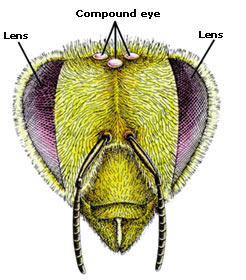
Bee’s Eyes

The bee’s eyes, like those of other insects, differ greatly from human eyes. They consist of a pair of compound eyes made up of numerous six-sided facets. They also have three simple eyes.  Despite this, their vision is believed to be sharp for a distance of only about 1 m (3 ft.).  The picture below highlights the three simple eyes as “Compound Eye” which is a mistake, I believe – but otherwise it is a good picture.  The two, large, compound eyes are titled “Lens”.

bees-eyes

Bees are capable of seeing ultraviolet light, which is invisible to humans. The bee is capable of navigating by ultraviolet light, which even penetrates cloud cover.

From: http://nature.ca/notebooks/english/bees.htm

Picture from: http://www.islamicmiraclestoday.com/honey-bee3/the-bees-eye.html

Read Full Post »

How a swarm locates a new nest site when less than 5% of the community know the way remains a mystery. Curious to find out how swarms cooperate and are guided to their new homes, Tom Seeley, a neurobiologist from Cornell University, and engineers Kevin Schultz and Kevin Passino from The Ohio State University teamed up to find out how swarms are guided to their new home and publish their findings on October 3rd 2008 in The Journal of Experimental Biology.

According to Schultz there are two theories on how swarms find the way. In the ‘subtle guide’ theory, a small number of scout bees, which had been involved in selecting the new nest site, guide the swarm by flying unobtrusively in its midst; near neighbours adjust their flight path to avoid colliding with the guides while more distant insects align themselves to the guides’ general direction. In the ‘streaker bee’ hypothesis, bees follow a few conspicuous guides that fly through the top half of the swarm at high speed.    Passino and Seeley decided to film swarming bees with high-definition movie cameras to find out how they were directed to their final destination.  

But filming diffuse swarms spread along a 12·m length with each individual on her own apparently random course is easier said than done. For a start you have to locate your camera somewhere along the swarm’s flight path, which is impossible to predict in most environments. The team overcame this problem by relocating to Appledore Island, which has virtually no high vegetation for swarms to settle on. By transporting large colonies of bees, complete with queen, to the island, the team could get the insects to swarm from a stake to the only available nesting site; a comfortable nesting box. Situating the camera on the most direct route between the two sites, the team successfully filmed several swarms’ chaotic progress at high resolution. 

Back in Passino’s Ohio lab, Schultz began the painstaking task of analysing over 3500 frames from a swarm fly-by to build up a picture of the insects’ flight directions and vertical position. After months of bee-clicking, Schultz was able to find patterns in the insects’ progress. For example, bees in the top of the swarm tended to fly faster and generally aimed towards the nest, with bees concentrated in the middle third of the top layer showing the strongest preference to head towards the nest.
 
Schultz also admits that he was surprised at how random the bees’ trajectories were in the bottom half of the swarm, ‘they were going in every direction,’ he says, but the bees that were flying towards the new nest generally flew faster than bees that were heading in other directions; they appeared to latch onto the high-speed streakers. All of which suggests that the swarm was following high-speed streaker bees to their new location.

More at: http://www.physorg.com/news142228088.html

Read Full Post »

Like trains of cars on tracks of plush
I hear the level bee:
A jar across the flowers goes,
Their velvet masonry

Withstands until the sweet assault
Their chivalry consumes,
While he, victorious, tilts away
To vanquish other blooms.

His feet are shod with gauze,
His helmet is of gold;
His breast, a single onyx
With chrysoprase, inlaid.

His labor is a chant,
His idleness a tune;
Oh, for a bee’s experience
Of clovers and of noon!


By Emily Dickinson (1830-1886); Poetry, Series One, Chapter 3: Nature, Poem XV: The Bee

From: http://classiclit.about.com/library/bl-etexts/edickinson/bl-ed-3-15-thebee.htm

Read Full Post »

The commercial bumblebees that are brought to greenhouses to pollinate some vegetables occasionally wander off the job, and researchers say the wayward bees that slip out into the fields are infecting their wild cousins with a nasty parasite. A new study says that parasite may be to blame for the recent decline in wild populations in North America and elsewhere [New Scientist].

Greenhouse growers bring in the bumblebees for tomatoes and other crops that need what’s called “buzz pollination,” a strong vibration that shakes loose the pollen. Honeybees don’t give the buzz, but bumblebees do [Science News]. In the study, published in the journal PLoS ONE, researchers observed several greenhouses in Canada, and saw bumblebees flying out of the greenhouses through vents. When commercial bees landed on flowers in the nearby fields, researchers say they left behind parasites that wild bees later picked up. They found that half of the wild bees living near the greenhouses were infected with the parasite, while those that lived farther away were disease-free.

The parasite of concern is Crithidia bombi, which is very common in commercial hives. The parasite robs bees of their ability to distinguish between flowers that contain nectar and those that don’t, [study coauthor Michael] Otterstatter said. For commercial bees fed by their owners, that skill isn’t important. For wild bees, its absence is deadly. “Infected bees make an incredible number of mistakes,” Otterstatter said. “They visit empty flowers again and again” as they slowly starve to death, he said [Bloomberg].

Although the C. bombi parasite doesn’t infect honeybees, whose plight has been in the news as scientists struggle to understand “colony collapse disorder,” researchers say it’s possible that a similar disease relationship exists between commerical and wild honeybees.

The news isn’t all grim for bumblebees: In Scotland, a group called the Bumblebee Conservation Trust has covered an empty field in wildflowers to create the world’s first bumblebee sanctuary. The project has already been an outstanding success, with hundreds of bumblebees buzzing from flower to flower. And to the delight of conservationists, one of the rarest species in the country – the blaeberry bumblebee – has set up home in the 20-acre meadow [The Scotsman].

From: http://blogs.discovermagazine.com/80beats/2008/07/25/commercial-bumblebees-spread-diseases-to-their-wild-kin/

Image: flickr/Clearly Ambiguous

Read Full Post »
“As busy as a bee.”

“What is good for the swarm is not good for the bee.”

“Where there is honey, there are bees.”

“One bee is better than a handful of flies.”

“If you want to gather honey, don’t kick over the beehive.”

“Honey turns sour.”

“The diligence of the hive produces the wealth of honey.”

“A drop of honey will not sweeten the ocean.”

=====================================

The proverbs are from Insect Fact and Folklore , by Lucy W. Clausen. Published by Collier Books, N.Y., 1954.

Read Full Post »

Honeybees are clever little creatures. They can form abstract concepts, such as symmetry versus asymmetry, and they use symbolic language — the celebrated waggle dance — to direct their hivemates to flower patches. New reports suggest that they can also communicate across species, and can count — up to a point.

With colleagues, Songkun Su of Zhejiang University in Hangzhou, China, and Shaowu Zhang of the Australian National University in Canberra managed to overcome the apian impulse to kill intruders and cultivated the first mixed-species colonies, made up of European honeybees, Apis mellifera, and Asiatic honeybees,A. cerana. The researchers confirmed that the two species have their own dialects: foraging in identical environments, the bees signaled the distance to a food source with dances of different durations.

Remarkably, despite the communication barrier, A. cerana decoded A. mellifera’s dance and found the food.

From: http://www.clipmarks.com/clipmark/AC3920A0-F84A-4A34-A1FD-02E2769308F6/

Read Full Post »

A bee comb has six sides,

on each a magic thing it hides:

Take wax, pollen and a spoon of honey 

which will make you healthy and sunny

Try propolis, royal jelly or venom

and you’ll enjoy bee’s poem!

Adapted from: http://www.bee-hexagon.net/

Read Full Post »

The properties of bees are wonderful noble and worthy. For bees have one common kind as children, and dwell in one habitation, and are closed within one gate: one travail is common to them all, one meat is common to them all, one common working, one common use, one fruit and flight is common to them all, and one generation is common to them all.

From: De proprietatibus rerum

Read Full Post »

« Newer Posts - Older Posts »