Feeds:
Posts
Comments

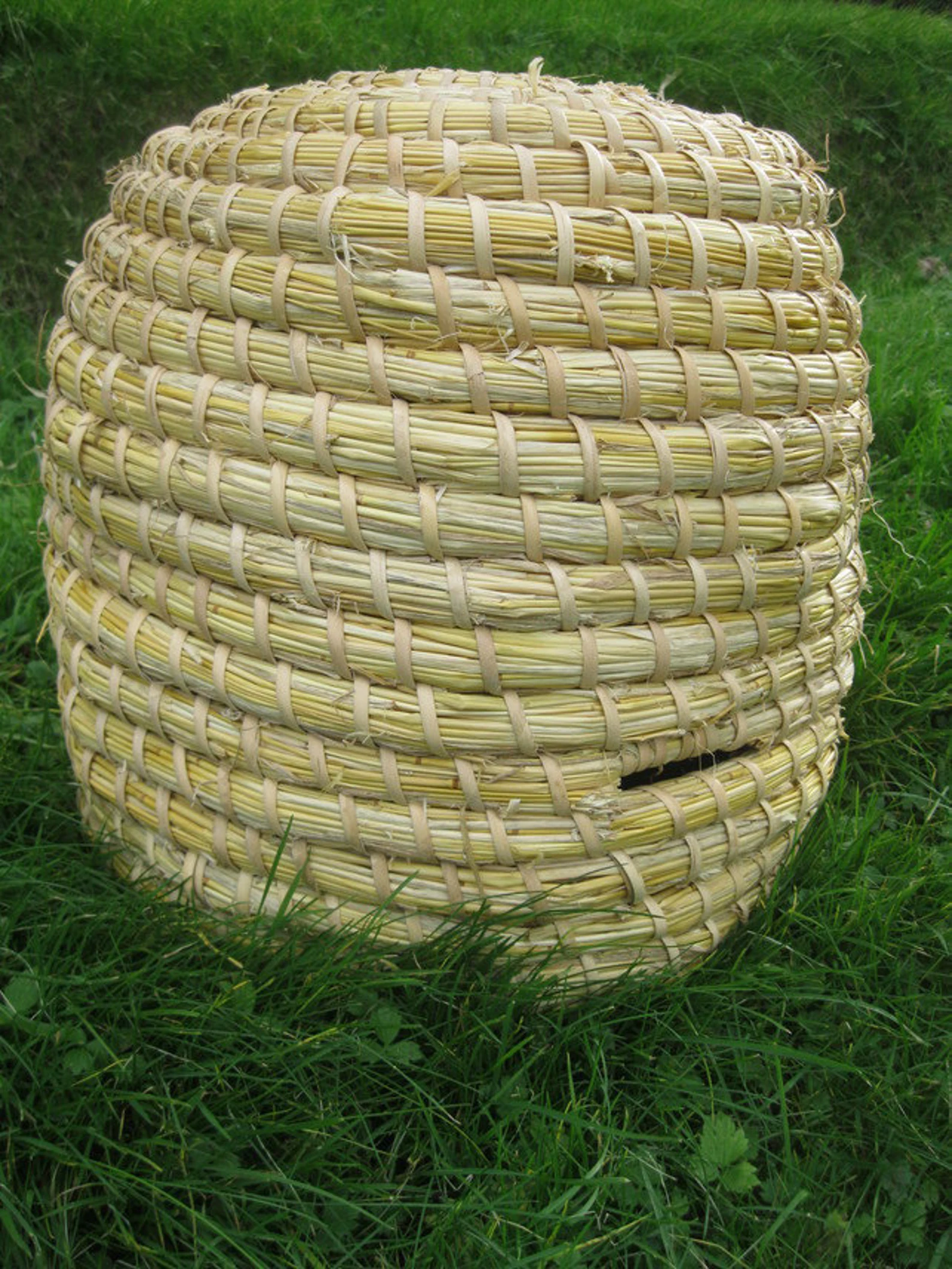
How to Build a Bee Skep

For centuries, beekeepers have used “skeps,” carefully designed domed baskets, to house their hives. Bees need a clean, dry place to make a home and “I guess beekeepers got tired of using hollowed out logs,” explains Kennard in a softly accented but very British voice. Northern European beekeepers migrated from logs to straw skeps somewhere between 800 and 1200 AD. Bridal couples in medieval Holland were given a skep to parade around the village as a symbol of starting a new home, and a swarm of bees as a wedding gift. But, once the modern Langstroth box hive was perfected and came into common use, bee skeps fell out of fashion.

Today, beekeepers are required to be able to easily open their hives for inspection and mite prevention, so skeps can no longer be legally used to house bees. And, you pretty much have to destroy your hive to get any honey. You can use a skep to capture a swarm, though. And they look pretty sweet and old-timey.

Although they are impractical for bees, Charlie says that there are lots of folks like him who want skeps. “I like having them around, because I guess I just like archaic things.”

If you are intrigued, as Charlie is, with the look and feel of an antique farm and garden, you might want to look at how to make a traditional English straw bee skep. Be forewarned, skep-making is a long and crafty process. It’s an ancient art, after all. And, there are ancient materials and tools involved. Plus about two days of repetitive work that can be hard on your wrists and fingers. Still curious? Here’s how to make one of your own:

Materials: First you need skep-making straw. Charlie uses “Harding grass” (Phalaris aquatica) which is considered an invasive grass, so gather it freely. Other grasses can be used, like rye straw. You’ll also need some cane for binding the grass together. Dried and split blackberry canes can be used, or purchase 5 mm rattan cane (the kind used to cane chairs).

Tools: If you’re going to do it right, you’re going to need old school tools, made from bones and stuff. Here’s what Charlie uses: A comb for removing the seed heads and straightening the grass stems, a hollow cylinder – called a “girth” – for shaping the grass coils (this one is made from a cow horn), an awl or two for pushing the cane through the coils of grass (turkey bones work well), a mallet (made from a tree branch), and some water in a bucket with a cup to wet down the canes and make them supple enough to bend (Charlie uses an abalone shell for this).

Then you need a lot of free time and some patience.

How to make a bee skep:

1. Soak your cane in water. As you take one out, put another in so that you’ll have soft cane throughout the process.

2. Comb out a handful of grass to make sure there are no leaves or seed heads. Smooth, soften and “de-kink” it with your comb. A leg protector can come in handy here, especially if you’re not too good with a sharp things.

3. Make sure your straw is pliable. A mallet helps.

4. Start by making the top of the basket. Take the end of your pre-soaked cane and insert it through the end of the straw bundle, then start wrapping the cane around the bundle to make the start of a coil. The smallest coils come first, so it’s the hardest part. Make three wraps of the cane, then put the third wrap through the middle. It’s called a “binding stitch.”

5. Sew the coil. Use an awl to make a space in the coil where you want your stitch and push the cane through the awl space and pull it out the other side. This can get tricky as you make the first coil.

6. Use the “girth” to add more straw to the end of your bundle. Make sure you put the ends of the new straw inside the existing coil straw so they don’t show. Try to get it to full thickness as soon as you can without making it look lopsided.

7. Stitch it up. Interlock the stitch you’re making with the two stitches right above it in the row you just coiled. Stitch spacing is crucial. The stitches have to look uniform, If they are too far apart, your skep will look wonky. This is the part that takes days and wrecks your hands.

8. Keep a uniform diameter. As you are stitching each coil, use a pattern cut of out cardboard that is the exact size of the inside of the skep as a guide to make sure your skep has a uniform diameter. The dimensions of skeps vary by tradition, but most have a slight bulge in the middle, and are narrower at the bottom. It makes carrying them easier.

9. Leave space for an opening. Be sure to leave about a 6-inch space in one coil without stitches for an opening to the skep. Charlie puts the entrance to the skep at about ¾ the distance from the top to allow easy bee access.

10. Cut out the hole. Once the skep is finished, cut out the space you left for the hole. Done. A perfectly made bee skep. If you’re storing it outside, be sure to put it in a little niche, under an eve, or somewhere where it will be protected from the elements.

This article first appeared on Modern Farmer and is republished here under a Creative Commons license.

In the great garden of Gaia, where consciousness bloomed like endless fields of wildflowers, there stood an extraordinary structure known as the Hive of Spheres.

Unlike ordinary beehives that housed honey and workers, this hive was the home to countless thoughts and dreams of humanity that pulsed with activity during daylight hours. Each sphere, centred on Gaia’s core, was stacked on top of the earth. Each layer vibrating at its own unique frequency of thoughts.

In the sphere closest to Gaia’s heart, the Extractosphere buzzed with thoughts of resources drawn from the Earth’s flesh – oil, minerals, and precious metals. These thoughts were heavy with purpose but tinged with worry, like bees carrying too much pollen.

Beyond it lay the Makeosphere, where creative thoughts transformed raw materials into tools and treasures, their energy spinning like workers crafting honeycomb.

Moving outward, the Packosphere hummed with thoughts of containment and preservation, while the Tradosphere buzzed with the exchange of goods and services, thoughts darting back and forth like bees performing their waggle dance. 

Further still, the Servosphere swirled with thoughts of helping and healing, and in the outermost ring, furthest from Gaia’s embrace, the Usosphere glowed with the consumption of all that had been extracted, made, packed, traded, and served.

During the day, humans moved through these spheres like busy worker bees, their thoughts confined to the rigid geometry of their roles and working their magic transforming products and services between the layers.

But as twilight descended upon Gaia, something remarkable happened. Just as bees return to their hive at dusk, humans returned to their homes – but their thoughts did not rest. Instead, they took flight into the night like luminous dream-bees, seeking the mysterious Change-Flowers that bloomed only in moonlight.

The Change-Flowers were unlike any other flowers in Gaia’s garden. Their petals shimmered with possibilities, each one reflecting a different potential future. Their stems grew from the rich soil of Gaia, but their blooms reached up towards the heavens of infinite potential. As the dream-thoughts settled upon these flowers, something magical occurred.

A young woman’s anxious thoughts about the Extractosphere’s drain on Gaia landed on a Change Flower’s midnight-blue petals. In its reflection, she saw new ways of harvesting energy from sun and wind. 

An elder’s worried thoughts about the Packosphere’s waste found a flower with silver-green petals that showed him visions of natural packaging that returned to the earth like autumn leaves.

Night after night, the dream-thoughts gathered nectar from the Change-Flowers, transforming fears into visions of possibility. 

They carried this precious cargo back to their sleeping humans, drop by drop, night by night. 

Slowly, the rigid spheres of the hive began to shift and flow, their boundaries becoming more permeable, their purposes more aligned with Gaia’s rhythms.

As the seasons turned, the Hive of Spheres gradually transformed. The Extractosphere learned to take only what could be renewed. The Makeosphere began creating in harmony with nature’s patterns. The Packosphere discovered the art of impermanence, while the Tradosphere found ways to exchange that enriched all participants. The Servosphere expanded to care for all of Gaia’s creatures, and the Usosphere learned the joy of using less to live more.

And so it was that the nightly dance of dream-thoughts and Change-Flowers slowly healed the relationship between humanity and Gaia. 

The Hive of Spheres remained, but it now pulsed in harmony with the planet’s heartbeat, its boundaries soft and flowing like honey, its purpose sweet with the nectar of consciousness transformed.

For just as bees are essential to the flowering of plants, so too are dreams essential to the flowering of human consciousness. And in the garden of Gaia, both continue their eternal dance of transformation. 

I’ve been a beekeeper for nearly 20 years, and I’ve never experienced such losses as I have this winter. At the end of the 2022 season, I had four healthy hives, but now I have only one – called “TRUTH”. Two of my strongest hives – JUBILEE (which was named in the Jubilee year of 2012 and flourished last year), and GRACE (which had been a very strong hive for the past three years) suddenly died off between February and March.

It’s been very disheartening to see my bees struggling to get through the winter and even more discouraging to hear about the losses experienced by other beekeepers. A friend of mine who has kept bees for 20 years and maintains over 100 hives lost half of his hives this winter and had 18 hives vandalised.

The loss of so many hives is devastating, not only for the beekeepers but also for the environment. I put it down to a very frosty, cold and wet winter and spring. I suppose it’s climate change in action. Whatever the reasons, it is making me do a radical re-think of how I can maintain and grow my colonies of bees in future years. I have to re-learn to split my remaining hive into two to ensure I have the resilience of two hives – a fundamental principle of small-scale beekeeping. Let’s hope the weather starts to get warmer and dryer in the next few months.

The Flower Moon

I’ve decided to post daily for a year (or more) on things that inspire me.

Today is the first day.

I’ve been very affected by the moon in the past few days with the FULL  FLOWER MOON. There was also an eclipse apparently – but I missed that.

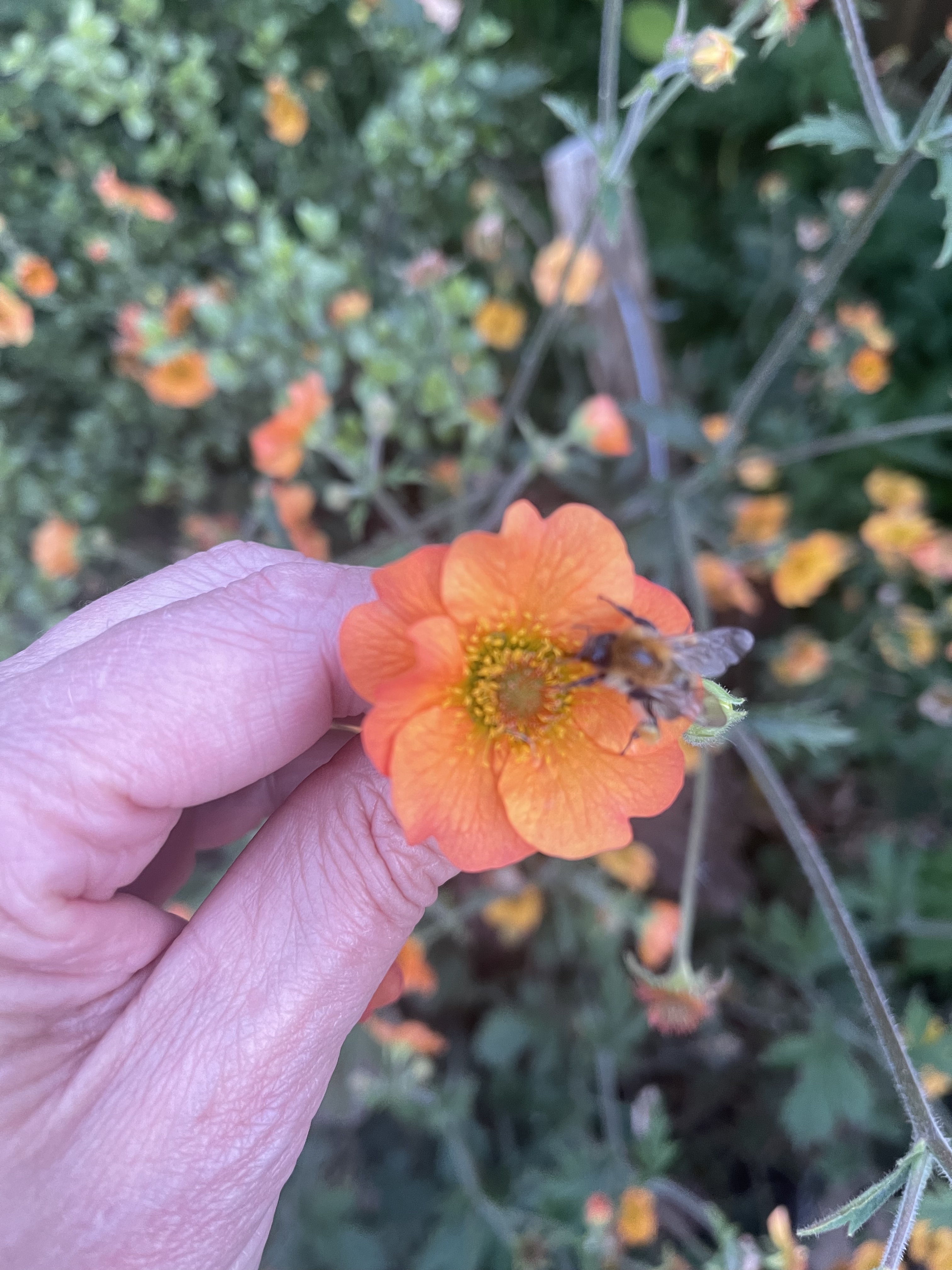
So, to get a subject for my first inspiring post, I decided to go into the garden to find a flower and after a few that were closed for the night, I came across a Geum (also Avens). It was perfect. The right colour and still out in all its glory.

As I held the delicate stem in my left hand and prepared to take the picture on my iPhone with my right hand, MAGIC HAPPENED!

At that very moment, a honey bee landed on the exact flowerhead I was filming!

I took the shot and it immediately buzzed off.

Why she wasn’t back in her nest, I will never know, save that I’m sure she was encouraging me in my quest.

So starts Day 1 in a truly magical way!

The flower Avens (or Geum) signifies Exorcism, Purification and Love, by the way.

I birthed a new hive this year and named it LOVE – not quite sure why at the time – but it felt right.

Now I know why.

Everything is connected!

#beelore

Australian Beehives on Fire

Large parts of South and East Australia have been ravaged by wildfires. The destruction of natural habitats has great impact for Australian beekeepers who produce 70-80% of their honey from forests.

There is some positive news: hive losses were minimised by the fast work of beekeepers who moved ahead of the fires and shifted bees outside of harm’s way.

People such as our friends at Beechworth Honey have helped beekeepers relocate hives to safe areas, away from fire risk. Beechworth is supporting Australia’s registered charity for bees, the Wheen Bee Foundation, and you can donate to their Bee Rebuild & Recovery Fund. (Photo Paul Valkenburg)

CLICK HERE TO FIND OUT MORE

(Extracted from Bees for Development Newsletter) February 2020

Many animals understand numbers at a basic level for use in essential tasks such as foraging, shoaling, and resource management. However, complex arithmetic operations, such as addition and subtraction, using symbols and/or labelling have only been demonstrated in a limited number of nonhuman vertebrates.

Honeybees have a miniature brain with less than 1 million neurons – compared to humans with over 80 billion.  New research (see below) shows that honeybees can learn to use blue and yellow as symbolic representations for addition or subtraction. In a free-flying environment, individual bees use this information to solve unfamiliar problems involving adding or subtracting one element from a group of elements.

This ability requires bees to acquire long-term rules and use short-term working memory. Given that honeybees and humans are separated by over 400 million years of evolution, the findings suggest that advanced numerical cognition may be more accessible to nonhuman animals than previously suspected.

And that humans and honeybees might well share a common ancestor from 600 million years ago that was just as smart!

From: “Numerical cognition in honeybees enables addition and subtraction”

by:

https://advances.sciencemag.org/content/5/2/eaav0961

On 28th September, I gave a talk to the London Dowsers.

It was the first opportunity to present the results of my efforts to replicate the amazing work done by John Harding who first introduced himself to me through this blog several years ago.

The content might be seen as some to be a bit “woo-woo” or unscientific.  However, in my experience, the honeybee is here to be a guide for us to show us the “space between” and there are plenty of stories in the video that illustrate the point.

You can watch a screencast of the lecture if you click on the video below:

https://youtu.be/58uCBm1Yv6s

There are many collective nouns for a group of bees:

  • bike of bees
  • charm of bees
  • cluster of bees
  • an erst of bees
  • game of bees
  • grist of bees
  • hive of bees
  • hum of bees
  • nest of bees
  • rabble of bees
  • swarm of bees

Source: https://socratic.org/questions/what-is-a-collective-noun-for-bees

Which one do readers like/prefer?  I love the “charm of bees” – for that is what they are!

However, my favourite collective noun remains a “congregation of drones” – as in a Drone Congregation Area.

I found this analysis of Drone Congregation Areas (DCAs) from a study done on Puerto Rico:

https://www.ncbi.nlm.nih.gov/pmc/articles/PMC3635128/

The conclusions are confusing and inconclusive and the way that the drones find the same sites year-after-year is still an area of study that is fascinating for me.

We took a late harvest this year.  With eight hives up and a very late summer, we have left quite a bit of honey on the hives.

It has been a lovely “Indian summer’ here in the UK – but the Autumn leaves are now turning and the cold is setting in.

We had success creating three new hives from three Buckfast queens sent in the post from Scotland.  It will be interesting to see if we can get all the hives through the winter.

Interested to know if anyone has any ideas on creative ways to use the propolis that ends up being dregs of honey and wax extraction.

Here’s to a mild winter!

Beelore


Samson’s Riddle

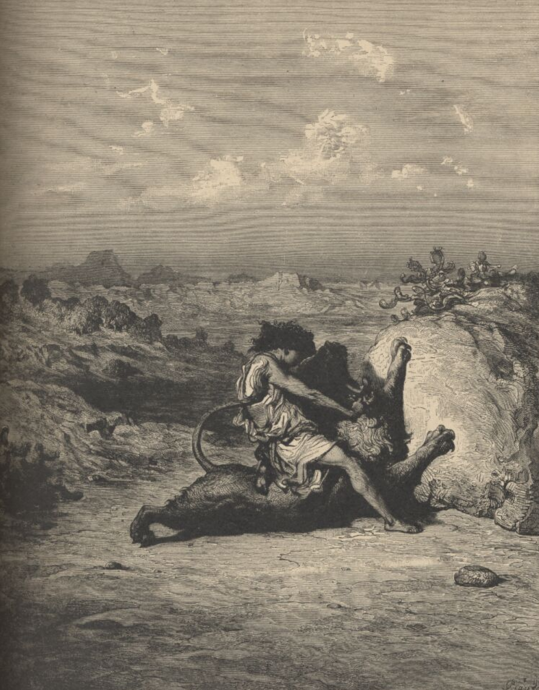
Samson’s riddle is a riddle that appears in the biblical narrative about Samson.

Samson posed the riddle to his thirty Philistine guests, in these words: “Out of the eater, something to eat; out of the strong, something sweet” (Judges 14:14).

Samson S

Samson slaying the lion by Dore

The riddle was based on a private experience of Samson, who killed a lion and after a while found bees and honey in its corpse.

(It is very interesting that there are other ancient references to bees taking up home in the dead carcasses of bulls and horses.  Perhaps the cavity and protection from nature provided an ideal home in areas where there were not so many trees or crevices?)

The Philistines, who could not solve the riddle, blackmailed the answer from Samson’s wife, who persuaded Samson to tell it to her.

“What is sweeter than honey? What is stronger than a lion?” (Judges 14:18) is the answer to the riddle.

Most of text from: Wikipedia