Feeds:
Posts
Comments

Archive for February, 2008

The oldest pictures of bee-keepers in action are from the Old Kingdom of Ancient Egypt.  In Niuserre’s sun temple bee-keepers are blowing smoke into hives as they are removing the honey-combs.  After extracting the honey from the combs it was strained and poured into earthen jars which were then sealed.  Honey treated in this manner could be kept years.  From the New Kingdom on, mentions of honey and depictions of its production become more frequent.

Pabasa Working Hives

Cylindrical hives like the ones in the picture above
from the tomb of Pabasa (7th century BCE)
were made of clay and stacked on top of each other.
Photograph is attributable to Dr. Kenneth Stein
and can be found at: http://www.virtualinsectary.com/egypt/egypt_15.htm

Bee-keeping methods are conservative in this region, well adapted to local conditions, for instance the kind of hives shown in these ancient reliefs, apparently woven baskets covered with clay, are still seen in the Sudan today.

The main centre of bee-keeping was Lower Egypt with its extensive cultivated lands, where the bee was chosen as a symbol for the country.  One of Pharaoh’s titles was Bee King, and the gods also were associated with the bee.  The sanctuary in which Osiris was worshiped was the Hwt bjt, the Mansion of the Bee.

There were itinerant apiarists in the Faiyum in Ptolemaic times using donkeys to transport their hives and possibly also beekeepers living by the Nile who loaded their hives onto boats, shipped them upriver in early spring, and then followed the flowering of the plants northwards as they were reported to do in the 19th century CE.

The Egyptians had a steady honey supply from their domesticated bees, but they seem to have valued wild honey even more. Honey hunters, often protected by royal archers, would scour the wild wadis for bee colonies.

I appointed for thee archers and collectors of honey, bearing incense to deliver their yearly impost into thy august treasury.

From: http://www.reshafim.org.il/ad/egypt/timelines/topics/beekeeping.htm

See also: https://beelore.com/2008/01/13/egypt-unites-the-reed-and-the-bee/

and:  https://beelore.com/2007/08/24/tears-of-ra-the-sun-god/

Read Full Post »

Cranach painted the first version of Cupid Complaining to Venus in 1527; in subsequent years, he and his workshop produced at least twenty-five versions of the theme, a fine example of which is now in the National Gallery.

Cupid complaining to Venus 

A Dürer watercolour of 1514, to which Cranach’s paintings are unrelated, is the earliest known visual interpretation of the theme in the Northern European artistic context.  The subject ultimately derives from pseudo-Theocritean Idyll XIX, (the Honey Thief), which tells the story of Cupid’s complaint to his mother after being stung by a bee as he was stealing a honeycomb. 

From: http://www.blackwell-synergy.com/doi/pdf/10.1111/j.1477-4658.2007.00337.x?cookieSet=1

Picture from: http://www.nationalgallery.org.uk/cgi-bin/WebObjects.dll/CollectionPublisher.woa/wa/largeImage?workNumber=NG6344&collectionPublisherSection=work

Read Full Post »

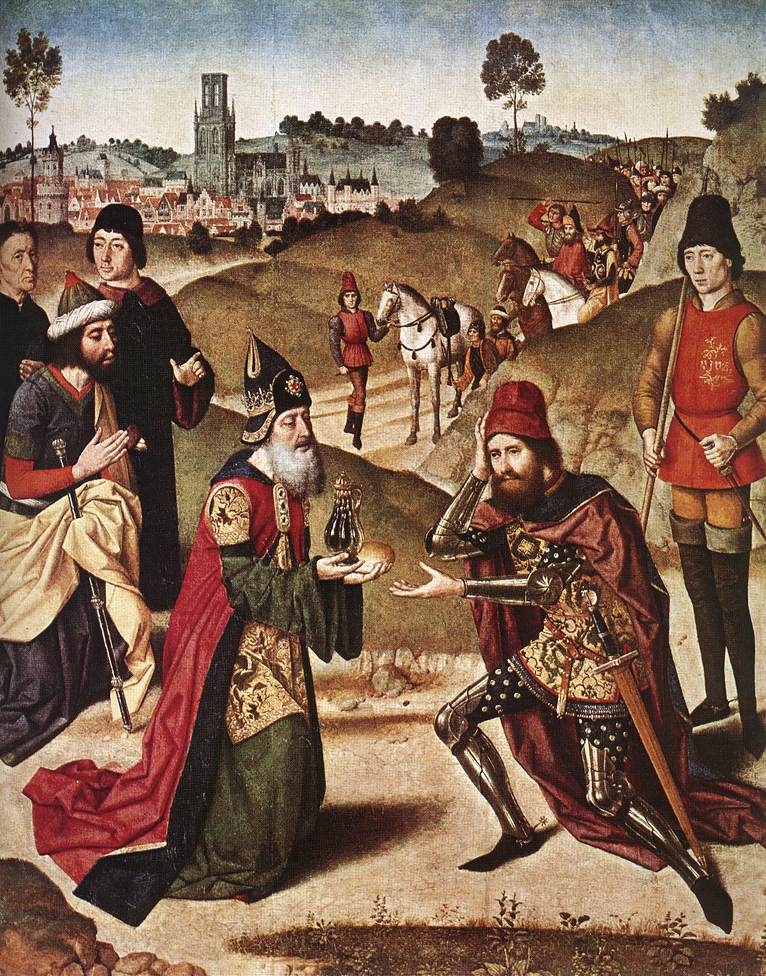
Occult tradition states that the mysterious figure Melchizedek, who is mentioned in the Bible in connection with giving communion to the patriarch Abraham, is an entity that brought three gifts to earth from the planet Venus: the bee, wheat, and the mineral asbestos. 

Meeting of abraham and melchizadek.jpg


The tradition is an allegorical one.  The meaning of the three gifts may be partially understood as symbolizing three grades of initiation. In the first grade, one serves (bee). In the second grade, the initiate focuses on understanding and practicing the development of the many out of the one (wheat). In the third grade, the initiate becomes a channel of the Divine Fire; he burns, but is not consumed (asbestos).

Story from: http://www.polarissite.net/page26.html

Picture from: http://en.wikipedia.org/wiki/Image:Meeting_of_abraham_and_melchizadek.jpg

Read Full Post »

“We have called this book the ‘Book of the Bee,’ because we have gathered of the blossoms of the two Testaments and of the flowers of the holy Books, and have placed them therein for thy benefit.

As the common bee with gauzy wings flies about, and flutters over and lights upon flowers of various colours, and upon blossoms of divers odours, selecting and gathering from all of them the materials which are useful for the construction of her handiwork; and having first of all collected the materials from the flowers, carries them upon her thighs, and bringing them to her dwelling, lays a foundation for her building with a base of wax; then gathering in her mouth some of the heavenly dew which is upon the blossoms of spring, brings it and blows it into these cells; and weaves the comb and honey for the use of men and her own nourishment: in like manner have we, the infirm, hewn the stones of corporeal words from the rocks of the Scriptures which are in the Old Testament, and have laid them down as a foundation for the edifice of the spiritual law.

And as the bee carries the waxen substance upon her thighs because of its insipidity and tastelessness, and brings the honey in her mouth because of its sweetness and value; so also have we laid down the corporeal law by way of substratum and foundation, and the spiritual law for a roof and ceiling to the edifice of the spiritual tower.

And as the expert gardener and orchard-keeper goes round among the gardens, and seeking out the finest sorts of fruits takes from them slips and shoots, and plants them in his own field; so also have we gone into the garden of the divine Books, and have culled therefrom branches and shoots, and have planted them in the ground of this book for thy consolation and benefit.

When thou, O brother, art recreating thyself among these plants, those which appear and which thou dost consider to be insipid and tasteless, leave for thy companions, for they may be more suitable to others (than to thee); but, upon those which are sweet, and which sweeten the palate of thy understanding, do thou feed and satisfy thy hunger.  If, however, owing to their fewness, they do not fill thee, seek in succession for their roots, and from thence shall thy want be satisfied.

Know also, O brother, that where there is true love, there is no fear; and where there is freedom of speech, there is no dread; and we should not dare to be so rash as to enter upon these subjects, which are beyond the capacity of our simple understanding, unless we relied upon thy immaculate love; because, in the words of one of the inspired, ‘When thou findest honey, eat (only) so much as is sufficient for thee, lest, when thou art sated, thou vomit it’; that is to say, do not enquire (too closely) into the divine words.”

======================================================

Extracted from the Book of the Bee – an historical/theological compilation containing numerous bible legends. It was written by Syrian Nestorian Solomon, Bishop of Bassora (c. 1222) in Syriac and translated into English by E.A. Wallis Budge in 1886.

From:  http://www.sacred-texts.com/chr/bb/bb00.htm

Read Full Post »

During the construction of the Panama Canal, a Dr. W.E. Auginbaugh described an operation he witnessed.  A native Indian surgeon performed this surgery while chain smoking in a filthy environment. He sutured the injury by setting beetles on the open wound.  The beetles snapped their mandibles shut and sealed it acting like staples.   The Doctor then cut off the beetle’s heads, covered the wound in honey and finished by covering it all with wax.  The results were excellent!

From: http://luna.clubyachats.com/index.php/food-for-thought/honey.html

Read Full Post »

In Hindu mythology, Surya represents the Sun god.  Surya is depicted as a red man with three eyes and four arms, riding in a chariot drawn by seven mares. Surya holds water lilies with two of his hands. With his third hand he encourages his worshipers whom he blesses with his fourth hand.  In India, Surya is believed to be a benevolent deity capable of healing sick people.  Even today, people place the symbol of the Sun over shops because they think it brings good fortune.

painting of Surya in his chariot

Myth has it that the Savins – who were the twin horsemen of the sun god Surya – acquired honey from celestial bees and brought it down to earth in a three-wheeled cart called a madhu-valhana.

Picture from:  http://www.goloka.com/docs/gallery/zodiac/surya.html

Bee Story from: http://luna.clubyachats.com/index.php/food-for-thought/honey.html

Read Full Post »

Similarly to the mythologies of other Finno-Ugric peoples, in Mordvin mythology the world has three levels: the upper world or the heaven (mdE&M Menel’), the middle world or the earth (mdE&M Moda), rimmed with the ocean, and the lower world or the underworld – the domain of coldness and darkness. In the Moksha tradition there was also a world pillar joining these three levels – a birch (mdM Kelu).

In the Erza tradition the world arrangement is patterned on a beehive and divided into four: the upper, the lower and two middle parts. Humans live in one of the middle hives; the other middle hive is inhabited by all kinds of living creatures. Each hive is under the rule and protection of a god who rules there as a ‘queen bee’. The ruler of the hive heaven Ineshkipaz (Nishkepaz) creates stars, which the Erza believe to be the souls of happy people. They live in shiny houses illuminated by sunbeams. The god is depicted as a man who keeps bees, souls twirling around him like bees. The god’s home is Ursa Major or the Balance (Mainof 1889: 109).

From: http://www.folklore.ee/folklore/vol17/mordmyth.pdf

Read Full Post »

Myth has it that the Mordvinian Ugro Finns had a chief God, chkai, a bisexual king bee responsible for creating the human race. These people believed that humans came from bees, they envisioned the earth as a beehive, ruled by the bee God chkai who laid eggs from which all bees and creating goddesses were born.

From: http://luna.clubyachats.com/index.php/food-for-thought/honey.html

Read Full Post »

Bless you, bless you, bonny bee:
Say, when will your wedding be?
If it be tomorrow day,
Take your wings and fly away.

From: http://www.rhymes.org.uk/a10-bless-you.htm

Read Full Post »

Top Bar Hives

I have just been browsing the internet and have come across an intriguing hive – called a Top Bar Hive.  It is much cheaper to build than a National or Langstroth and the keeping of these hives is probably much more similar to the methods that  ancient beekeepers would have used.  Honey is not extracted from frames but is pressed from natural comb.  There is now also a reasonable amount of research into the natural size of cells – and how Top Bar Hives can create a home for a colony that is more like the bees would make in the wild.  Here is a good diagram explaining more:

Read Full Post »

Older Posts »