Feeds:
Posts
Comments

Archive for August, 2007

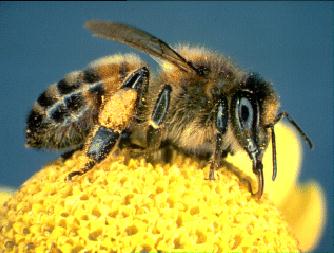
According to one ancient egyptian myth, honey bees were the tears of the sun god Ra.  In this context, the bee was seen as the messenger of the gods, falling down, like tears, towards the earth (and man) to pass on some secret message.


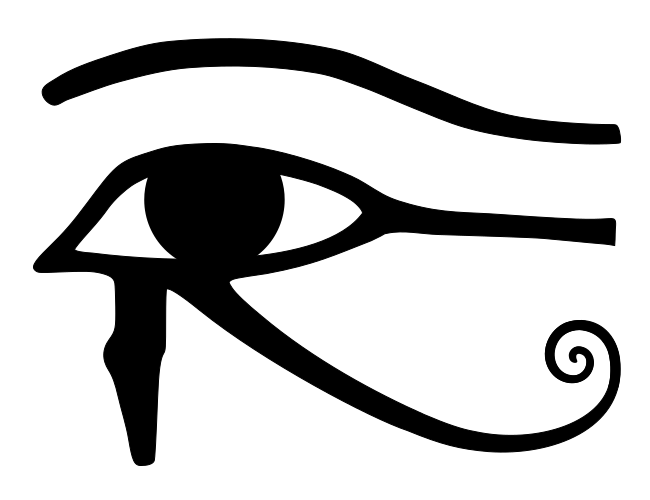
The above symbol was called the Udjat in ancient times.  It is now more commonly called the Eye of Ra or Eye of Horus and represents the right eye of the Egyptian Falcon God Horus and was also associated with the Sun God Ra.  It is supposed to be where the tears (or bees) came from.

According to another legend, the left eye was torn from Horus by his brother Seth. It was magically restored by Thoth, the God of Magick.  After the restoration, some stories state, Horus made a gift of the eye to Osiris, which allowed this solar deity to rule the underworld.

The Eye of Horus was also believed to have healing and protective power, and it was used as a protective amulet, and as a medical measuring device, using the mathematical proportions of the eye to determine the proportions of ingredients in medical preparations) to prepare medications. The Egyptians did write prescriptions. Those prescriptions were composed first of magical verses and then secondly the real prescription. The Eye of Horus was an important part of the magical part of the prescription. With time the magical part became smaller, and the real prescription more important.  Eventually, all that was left of the magical verse was the Eye of Horus. The sign has remained in pharmacist’s shorthand to this day with Rx being the sign for a prescription!  Many bee products are used for healing and it is likely that there the direct connection between bees and good health goes back before Ancient Egypt.

Together, the left and right eyes represented the whole of the universe, a concept similar to that of the Taoist Yin-yang symbol.  Spiritually, the right eye reflects solar, masculine energy, as well as reason and mathematics.  The left eye reflects fluid, feminine, lunar energy, and rules intuition and magic.  Together, they represent the combined, transcendent power of Horus.

Read Full Post »

bee-on-floweri.jpg

Read Full Post »

Legend has it that about 4,000 years ago, in Babylon, the bride’s father gave his son-in-law honey beer or meade for a whole month (or moon) after the wedding ceremony.  Alcoholic honey for a month, with plenty of time for the couple to enjoy time together!  Quite a difference from today’s tradition of a honeymoon being long holiday away from home – and normally much less than a month!

Read Full Post »

A story of eastern European origin probably derives from a time when many gods were worshipped, later being altered to conform with the Christian monotheistic concept:

The devil was spying on God when He was creating the birds and insects. God took a bit of mist from the air, spun it in His fingers and called out the name of the new creature, “Bee!” And so the first bee was brought to life. The devil was a bit confused by what he saw and thought that God had called the creature into existence by telling it to “Be!” So when he tried a similar trick, gathering up a bit of clay from the earth and mixing it with his own sweat he told it to “Fly!” Of course, in this way it was not another beautiful bee that was formed but the ugly and pesky fly that, ever since, has plagued humans as much as bees have benefitted them.

From: http://healing.about.com/gi/dynamic/offsite.htm?zi=1/XJ&sdn=healing&zu=http%3A%2F%2Fwww.geocities.com%2FTimesSquare%2FLabyrinth%2F2398%2Fbginfo%2Fbeast%2Fbees.html

(The author altered the “letter” of the story a bit to maintain its spirit. In the original, Hungarian, version the word-play centers on “legy” meaning both “become” and a “fly”).

Read Full Post »

Three weeks ago, we moved house……swarmed……for more space.  Which is why there have not been many entries in the last few weeks.  As a result, the Bees have also not had much attention – though the August honey harvest is overdue.  I will visit the hives in the next few days – weather permitting.

Read Full Post »

(From Leo Tolstoy’s War & Peace: Chapter IV)

 As the sun and each atom of ether is a sphere complete in itself, and yet at the same time only a part of a whole too immense for man to comprehend, so each individual has within himself his own aims and yet has them to serve a general purpose incomprehensible to man.

A bee settling on a flower has stung a child. And the child is afraid of bees and declares that bees exist to sting people. A poet admires the bee sucking from the chalice of a flower and says it exists to suck the fragrance of flowers. A beekeeper, seeing the bee collect pollen from flowers and carry it to the hive, says that it exists to gather honey. Another beekeeper who has studied the life of the hive more closely says that the bee gathers pollen dust to feed the young bees and rear a queen, and that it exists to perpetuate its race. A botanist notices that the bee flying with the pollen of a male flower to a pistil fertilizes the latter, and sees in this the purpose of the bee’s existence. Another, observing the migration of plants, notices that the bee helps in this work, and may say that in this lies the purpose of the bee. But the ultimate purpose of the bee is not exhausted by the first, the second, or any of the processes the human mind can discern. The higher the human intellect rises in the discovery of these purposes, the more obvious it becomes, that the ultimate purpose is beyond our comprehension.

All that is accessible to man is the relation of the life of the bee to other manifestations of life. And so it is with the purpose of historic characters and nations.


Read Full Post »

The Queenless Hive

Meanwhile Moscow was empty. There were still people in it, perhaps a fiftieth part of its former inhabitants had remained, but it was empty. It was empty in the sense that a dying queenless hive is empty.

In a queenless hive no life is left though to a superficial glance it seems as much alive as other hives. The bees circle round a queenless hive in the hot beams of the midday sun as gaily as around the living hives; from a distance it smells of honey like the others, and bees fly in and out in the same way. But one has only to observe that hive to realize that there is no longer any life in it. The bees do not fly in the same way, the smell and the sound that meet the beekeeper are not the same. To the beekeeper’s tap on the wall of the sick hive, instead of the former instant unanimous humming of tens of thousands of bees with their abdomens threateningly compressed, and producing by the rapid vibration of their wings an aerial living sound, the only reply is a disconnected buzzing from different parts of the deserted hive.

From the alighting board, instead of the former spirituous fragrant smell of honey and venom, and the warm whiffs of crowded life, comes an odour of emptiness and decay mingling with the smell of honey. There are no longer sentinels sounding the alarm with their abdomens raised, and ready to die in defence of the hive. There is no longer the measured quiet sound of throbbing activity, like the sound of boiling water, but diverse discordant sounds of disorder. In and out of the hive long black robber bees smeared with honey fly timidly and shiftily. They do not sting, but crawl away from danger. Formerly only bees laden with honey flew into the hive, and they flew out empty; now they fly out laden.

The beekeeper opens the lower part of the hive and peers in. Instead of black, glossy bees- tamed by toil, clinging to one another’s legs and drawing out the wax, with a ceaseless hum of labour- that used to hang in long clusters down to the floor of the hive, drowsy shrivelled bees crawl about separately in various directions on the floor and walls of the hive. Instead of a neatly glued floor, swept by the bees with the fanning of their wings, there is a floor littered with bits of wax, excrement, dying bees scarcely moving their legs, and dead ones that have not been cleared away. The beekeeper opens the upper part of the hive and examines the super. Instead of serried rows of bees sealing up every gap in the combs and keeping the brood warm, he sees the skilful complex structures of the combs, but no longer in their former state of purity. All is neglected and foul.

Black robber bees are swiftly and stealthily prowling about the combs, and the short home bees, shrivelled and listless as if they were old, creep slowly about without trying to hinder the robbers, having lost all motive and all sense of life. Drones, bumblebees, wasps, and butterflies knock awkwardly against the walls of the hive in their flight. Here and there among the cells containing dead brood and honey an angry buzzing can sometimes be heard. Here and there a couple of bees, by force of habit and custom cleaning out the brood cells, with efforts beyond their strength laboriously drag away a dead bee or bumblebee without knowing why they do it. In another corner two old bees are languidly fighting, or cleaning themselves, or feeding one another, without themselves knowing whether they do it with friendly or hostile intent. In a third place a crowd of bees, crushing one another, attack some victim and fight and smother it, and the victim, enfeebled or killed, drops from above slowly and lightly as a feather, among the heap of corpses.

The keeper opens the two centre partitions to examine the brood cells. In place of the former close dark circles formed by thousands of bees sitting back to back and guarding the high mystery of generation, he sees hundreds of dull, listless, and sleepy shells of bees. They have almost all died unawares, sitting in the sanctuary they had guarded and which is now no more. They reek of decay and death. Only a few of them still move, rise, and feebly fly to settle on the enemy’s hand, lacking the spirit to die stinging him; the rest are dead and fall as lightly as fish scales. The beekeeper closes the hive, chalks a mark on it, and when he has time tears out its contents and burns it clean.

So in the same way Moscow was empty when Napoleon, weary, uneasy, and morose, paced up and down in front of the Kammer-Kollezski rampart, awaiting what to his mind was a necessary, if but formal, observance of the proprieties- a deputation. In various corners of Moscow there still remained a few people aimlessly moving about, following their old habits and hardly aware of what they were doing. When with due circumspection Napoleon was informed that Moscow was empty, he looked angrily at his informant, turned away, and silently continued to walk to and fro. “My carriage!” he said. He took his seat beside the aide-de-camp on duty and drove into the suburb. “Moscow deserted!” he said to himself. “What an incredible event!” He did not drive into the town, but put up at an inn in the Dorogomilov suburb. The coup de theatre had not come off.

From: (From Leo Tolstoy’s War & Peace: Book Eleven: 1812 – Chapter XX)

Read Full Post »
Insomniacs

Honeybees never sleep!

Read Full Post »

The worker bee, which is always a female, will live from 6 to 8 weeks and only produce 1/12 of a teaspoon of honey in her lifetime, so don’t forget to lick the spoon!

Read Full Post »

It takes 2 million flower visits and 55,000 miles of flying for the bees to make just one pound of honey!

Read Full Post »